← Private Well Water Directory / Connecticut
Connecticut Private Well Water Quality 2026
Around 23% of Connecticut residents — approximately 823,000 people — rely on private wells for drinking water, with no requirement to test after the initial installation. A landmark October 2024 USGS study found that between 67% and 87% of Connecticut private well users could be drawing from groundwater affected by PFAS. Add naturally elevated arsenic and uranium from the state’s bedrock geology, and Connecticut well owners face one of the most complex contamination pictures in the Northeast.
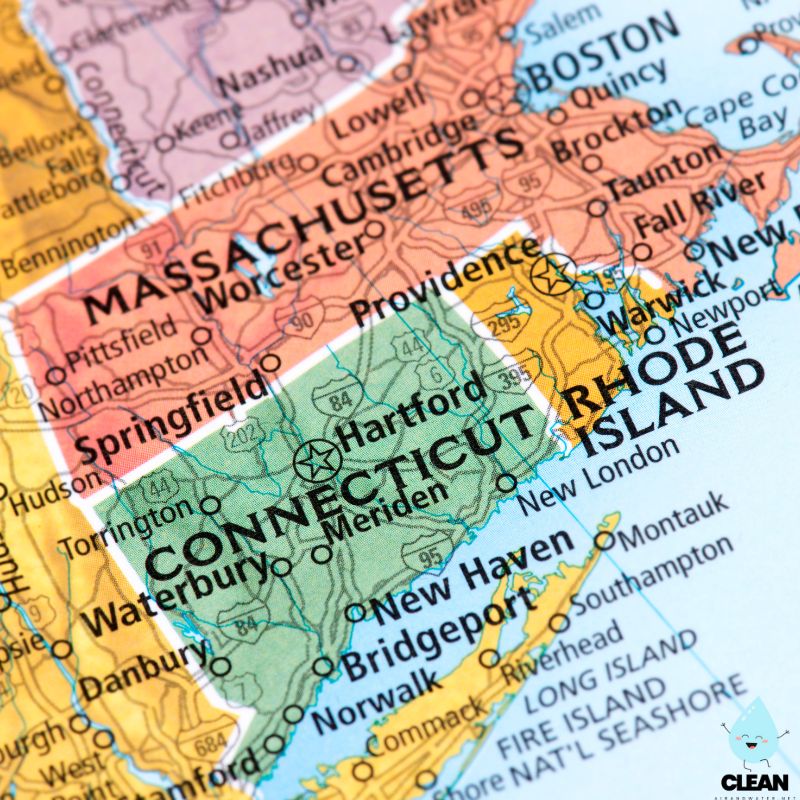
PFAS in Connecticut Well Water: A Statewide Risk
A landmark study published by the US Geological Survey on October 24, 2024 produced the first national predictive model for PFAS in groundwater — and Connecticut emerged as one of the most at-risk states in the country. The research found that between 67% and 87% of Connecticut residents who rely on private wells could be drawing from groundwater sources affected by PFAS. Connecticut and Massachusetts ranked as the states with the highest population percentages at risk from groundwater PFAS exposure.
The USGS model uses eight predictive factors — urban land use, well depth, nitrogen loading from septic systems, and population density among them. The accompanying probability map shows that almost all of southwestern Connecticut and the coastline, along with much of central Connecticut, have a greater than 75% probability of PFAS being present at the depth of private wells. Northeastern Connecticut and the Northwest Hills show a considerably lower probability because of lower population density and less intensive land use. The model identifies the probability of PFAS presence — not concentration. Local testing is the only way to confirm whether PFAS is in a specific well and at what level.
The contamination picture in Connecticut’s public water systems reflects the wider groundwater problem. Aquarion Water Company — serving around 695,000 customers — has detected PFAS above 4 parts per trillion in sources supplying parts of Darien, Simsbury, Danbury, Woodbury, New Fairfield, New Milford, Greenwich, and Newtown, among others. Connecticut Water, serving more than 243,000 people, documented similar findings at systems in Avon, Vernon, Brooklyn, Guilford and other locations. Manchester’s water department recorded PFAS as high as 21 ppt at one of its intake locations. Connecticut Water alone expects to spend over $190 million on infrastructure upgrades to treat PFAS. Private wells receive none of this systematic monitoring.
A separate private analysis identified 693 locations across Connecticut as strong candidates for PFAS contamination, spanning abandoned sites and active businesses. All of Connecticut’s major cities and larger towns had at least one suspected source — some, including Waterbury, Danbury, Putnam, Orange, Wallingford, and New Britain, had dozens.
Connecticut has been proactive on PFAS regulation. CT DPH established Drinking Water Action Levels for four PFAS — PFOA, PFOS, PFNA, and PFHxS — in June 2022, then extended coverage to a total of ten PFAS compounds in June 2023. The Connecticut PFAS Action Plan directed DEEP to identify and prioritise testing of private wells near suspected or confirmed contamination sources. In 2024, the State Bond Commission allocated $3 million to DEEP for PFAS well testing focused on socially vulnerable and environmental justice communities. But this is targeted, community-specific action — it does not constitute comprehensive coverage for the state’s 322,600 private wells.
Arsenic and Uranium: Connecticut’s Bedrock Problem
Independent of PFAS, Connecticut well owners face a serious naturally occurring contamination risk from arsenic and uranium. Connecticut’s crystalline bedrock geology — the same geology that makes the state geologically distinct in New England — is a documented source of both contaminants leaching into groundwater.
A USGS study conducted in cooperation with CT DPH, drawing on samples from more than 2,000 private wells collected between 2013 and 2018, found that approximately 3.9% of Connecticut’s bedrock wells contain arsenic above the EPA maximum contaminant level of 10 micrograms per litre, and 4.7% contain uranium above the EPA MCL of 30 micrograms per litre. Across 115 geologic units studied, 44 had at least one sample exceeding the MCL for either contaminant. The CT DPH Private Well Programme supervisor has stated explicitly: any private well in Connecticut has the potential to have elevated arsenic or uranium.
Critically, routine well testing in Connecticut does not include arsenic or uranium as standard — both must be specifically requested. A well owner who has had their water tested may still be unknowingly consuming water contaminated with either. Glastonbury launched a community-wide uranium testing programme after elevated levels were found in private wells, driven by local Glastonbury Gneiss bedrock. Stamford health officials issued a specific uranium warning after elevated levels were discovered in a significant proportion of wells tested locally.
Long-term arsenic exposure is linked to cancer, cardiovascular disease, and developmental problems in children. Uranium toxicity at groundwater concentrations is primarily a kidney concern rather than a radiation risk, but long-term exposure above the MCL carries real health implications. Neither contaminant has any taste, smell, or colour — they can only be identified through laboratory testing.
Quick Important Advertisement – Boil Water Alerts continue below
Don’t Wait for the Next Emergency to Act
Boil water alerts are a warning sign. Whether caused by pipe breaks, contamination, or natural disasters, they highlight how vulnerable our water systems can be.
The safest long-term solution? A reliable home water filtration system designed to remove bacteria, parasites, and harmful chemicals — so you’re protected even when advisories are issued.
Stay Ready with Trusted Filtration:
✅ Removes pathogens, chlorine, PFAS, and heavy metals
✅ Safer than boiling alone — no need to wait for alerts
✅ Easy options for homes, renters, and families
Prefer no installation? Check out the A2 Countertop System
Note: This advert may contain affiliate links. If you choose to buy, we may receive a small commission — thank you for supporting our work!
Radon, Nitrate, and Other Contaminants
Radon is a naturally occurring radioactive gas that dissolves into groundwater from uranium-bearing bedrock — the same geology responsible for Connecticut’s uranium risk. Radon in well water can off-gas into the home during showering or washing, creating an inhalation exposure risk in addition to the ingestion risk. Connecticut health officials have flagged radon as a concern for well owners in areas with uranium-bearing bedrock, including parts of Glastonbury and towns across the greater Hartford region.
Nitrate contamination is a risk in areas where shallow wells are located near agricultural land, older septic systems, or high-density residential development on individual septic tanks. The USGS PFAS study identified nitrogen loading from septic systems as one of the key predictive factors for groundwater contamination — meaning that in areas of high septic density, both nitrate and PFAS risks are elevated simultaneously. High nitrate levels are particularly dangerous for infants under six months, where they can cause methemoglobinemia, or “blue baby syndrome.”
PFAS from consumer products flushed into septic systems is an increasingly understood contamination pathway. CT DPH has confirmed that PFAS compounds from everyday household products — shampoos, cleaning agents, and food packaging — can be washed into septic systems and leach into nearby groundwater. This pathway is relevant across all of Connecticut’s residential areas that rely on septic rather than municipal sewer, and it is one reason high-density septic areas carry elevated PFAS groundwater probability.
Regulatory Situation for Connecticut Well Owners
Private residential wells in Connecticut are not regulated under the Safe Drinking Water Act, which applies only to public water systems. The only legally mandated testing moment is when a new well is drilled — after that, testing is entirely at the owner’s discretion. As CT DPH’s Private Well Programme supervisor has stated, a homeowner could live on well water for thirty or forty years after installation without a single additional test and face no legal consequence.
DEEP’s Potable Well Programme has authority to investigate wells where contamination results from human activity — PFAS falls into this category as it is entirely man-made. DEEP can provide homeowners with a certified lab list and, in some cases, offer bottled water or treatment system support to households within an active DEEP investigation area. This resource is limited and site-specific; it is not a substitute for proactive testing by individual well owners. The scale of the problem is considerable — Connecticut Water alone expects to dedicate over $190 million to PFAS treatment infrastructure upgrades across its public systems.
CT DPH’s online resource at testyourwell.ct.gov provides guidance on when to test, what to test for, and what to do if contamination is found. This is the recommended starting point for any Connecticut well owner who has not tested recently. For the municipality-specific drinking water picture, see our Connecticut tap water quality page or use our live boil water notice tracker for active advisories.
Known Higher-Risk Areas in Connecticut
PFAS groundwater risk is highest in southwestern and central Connecticut. Arsenic and uranium risk is geology-dependent and statewide — no area can be considered categorically safe without testing.
Southwestern Connecticut
Darien, Greenwich, New Fairfield, and surrounding Fairfield County towns show PFAS in public water sources. The USGS probability map rates most of this region above 75% for groundwater PFAS. Well owners here face the highest regional risk in the state.
Central CT — Aquarion & CT Water Areas
Towns including Newtown, Simsbury, Woodbury, Avon, Vernon, and Guilford have seen PFAS detected in public water systems. The same underlying groundwater means private wells in surrounding areas may be similarly affected.
Enfield, Colchester & Cromwell
PFAS was detected in public water systems in all three towns in 2023 — in some cases for the first time. These findings reflect broader groundwater contamination. Private well owners in surrounding areas should treat testing as a priority.
Killingly, Windham County
An active DEEP PFAS investigation running from 2025 into 2026 found many private wells exceeding CT DPH action levels. DEEP has provided free testing and treatment to affected residents. The contamination source was under investigation as of early 2026.
Glastonbury & Stamford
Glastonbury launched a community-wide uranium testing programme after elevated levels were found in private wells, tied to local bedrock geology. Stamford health officials issued a uranium warning after elevated levels were found in a significant proportion of locally tested wells.
Statewide — Arsenic & Uranium
CT DPH and USGS confirm that any private well in Connecticut could have elevated arsenic or uranium. Of 115 geologic units studied, 44 had at least one well exceeding EPA limits for either contaminant. All well owners should test regardless of location.
How to Test Your Connecticut Well Water — and What to Do Next
Connecticut law only requires well testing at the point of installation. After that, you are responsible for your own water quality. Given the combination of PFAS risk from industrialisation and septic density, plus naturally occurring arsenic, uranium, and radon from bedrock geology, CT DPH’s own advice is clear: all private well owners should test, and they should test for more than the basic panel.
Start at testyourwell.ct.gov — CT DPH’s dedicated resource for well owners — which walks you through what to test for based on your location and provides a current list of certified laboratories. For PFAS, CT DEEP recommends EPA Method 533, and laboratory costs are typically $300 or more per sample. Households in an active DEEP investigation area — such as Killingly in 2025–2026 — receive free testing and treatment installation directly from DEEP.
If your results show PFAS above CT DPH action levels, contact DEEP at DEEP.PFAS@ct.gov or call 860-424-3061. For naturally occurring contamination such as arsenic or uranium, contact CT DPH’s Private Well Programme on 860-509-8401 or your local health department. The Connecticut Institute of Water Resources at UConn also provides testing support and help interpreting results.
For filter options, our well water filter guide covers reverse osmosis systems for PFAS, arsenic, and uranium, UV disinfection for bacteria, and whole-house systems for comprehensive well water treatment. You can also browse our full water filter solutions page or check your ZIP code for local water quality context.
For other Northeast well water risks, see our pages on Maine wells, New Hampshire wells, and North Carolina wells. Return to the private well water directory to find your state.
Quick Important Advertisement – Boil Water Alerts continue below
Don’t Wait for the Next Emergency to Act
Boil water alerts are a warning sign. Whether caused by pipe breaks, contamination, or natural disasters, they highlight how vulnerable our water systems can be.
The safest long-term solution? A reliable home water filtration system designed to remove bacteria, parasites, and harmful chemicals — so you’re protected even when advisories are issued.
Stay Ready with Trusted Filtration:
✅ Removes pathogens, chlorine, PFAS, and heavy metals
✅ Safer than boiling alone — no need to wait for alerts
✅ Easy options for homes, renters, and families
Prefer no installation? Check out the A2 Countertop System
Note: This advert may contain affiliate links. If you choose to buy, we may receive a small commission — thank you for supporting our work!
Quality News About Your Water
Get the comprehensive water quality news coverage you need with our dedicated US Water News Service. From coast to coast, we deliver in-depth reporting and expert analysis on PFAS contamination, EPA regulatory changes, infrastructure developments, and emerging water safety issues affecting communities nationwide. While mainstream media only covers the biggest stories, we provide the detailed, ongoing coverage that helps you understand the full scope of America’s water challenges.
What’s actually in your tap water? Enter your ZIP code for a full breakdown of contaminants detected in your local supply
Drinking water from a well? Check our directory here for more information

Please read – our information
The information presented on cleanairandwater.net is compiled from official water quality reports, trusted news sources, government websites, and public health resources. While we strive for accuracy and thoroughness in our presentations, we are not scientists, engineers, or qualified water quality professionals.
Our mission is to present water quality information in an accessible, real-world format that helps people understand what’s in their water and make informed decisions about their health and safety. We believe that complex environmental information should be available to everyone in a format that’s easy to understand.
We make every effort to ensure our content is current and accurate, but we cannot guarantee that all information is complete or error-free. This website should not replace official communications from your local water utility or health department. We always recommend consulting official sources for the most up-to-date information regarding your specific water system.
Clean Air and Water is not liable for any unintentional errors, omissions, or outdated information. The content on this site is provided for informational purposes only and should not be considered professional advice.