← Private Well Water Directory / Missouri
Missouri Private Well Water Quality 2026
More than 1.4 million Missourians rely on private wells for their drinking water — and none of those wells are protected under the Safe Drinking Water Act. With active PFAS contamination from military bases, nitrate pressure across agricultural counties, heavy metal legacy in the lead mining regions, and Ozark karst geology that channels surface pollutants directly into groundwater, Missouri well owners face a layered set of risks that only regular testing can reveal.
PFAS Contamination from Military Bases and Industrial Sites
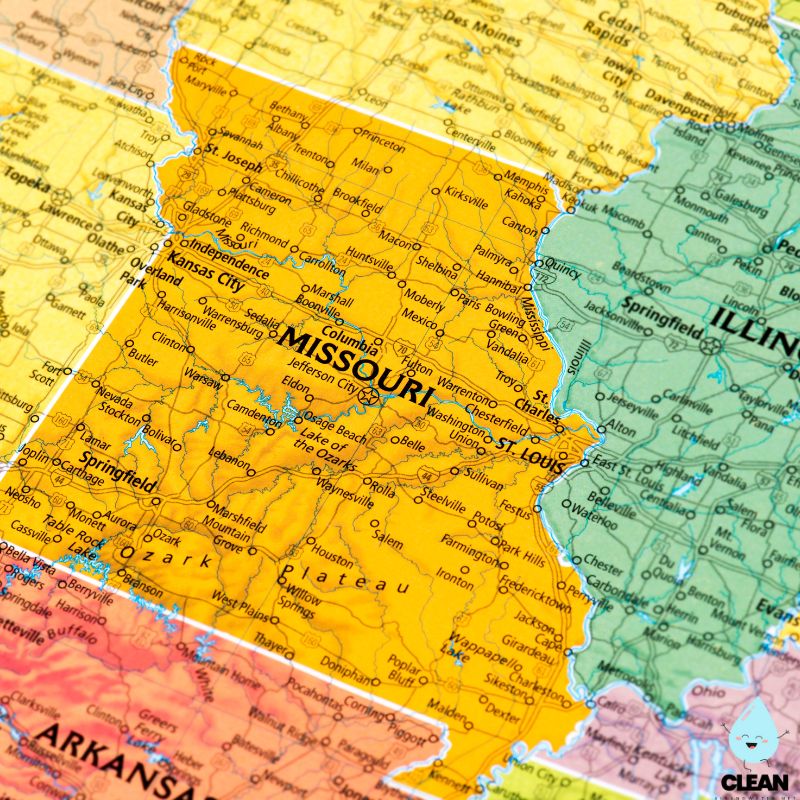
Missouri has multiple confirmed PFAS contamination sources affecting groundwater, and private wells near these sites are at direct risk. The primary driver is the historical use of Aqueous Film Forming Foam (AFFF) at military installations across the state. Whiteman Air Force Base near Knob Noster, Fort Leonard Wood in Pulaski County, and the former Richards-Gebaur Air Force Base in the Kansas City area have all been identified as PFAS contamination sites, with the Missouri Department of Natural Resources actively monitoring groundwater at each location.
At Whiteman AFB, groundwater sampling has confirmed PFAS contamination at multiple on-site locations resulting from decades of AFFF use in firefighting training. One on-site test in 2018 recorded a concentration of 89,000 parts per trillion. While the base’s own drinking water supply draws from a deep aquifer and has tested non-detect for PFAS, controls are in place to prevent the construction of new drinking water wells anywhere on the base. Residents in surrounding communities who rely on private wells are identified by the US Air Force’s own CERCLA response as a potentially exposed group, and private well testing near the base is treated as a priority concern.
Beyond military bases, municipal PFAS testing has revealed the broader scale of Missouri’s contamination picture. In 2024, at least five public water systems recorded PFAS levels above federal limits — including St. Robert (PFOS at 2.8 times the federal 4 ppt limit), Camdenton (2.5 times), Beaufort Circle C Mobile Home Park (1.3 times), St. James (1.2 times), and St. Peters (PFOAs at 1.2 times). These are systems drawing from groundwater. If nearby public systems are detecting PFAS above 4 ppt, untested private wells in the same regions face comparable or greater risk.
PFAS also enters Missouri groundwater through biosolids — sewage sludge containing PFAS that is routinely applied to agricultural land as fertiliser. Testing by Missouri Confluence Waterkeeper in 2022 found that the highest total PFAS concentration in the Midwest region came from a sample taken downstream from Coldwater Creek in north St. Louis County — a waterway already heavily contaminated with radioactive Manhattan Project waste.
Nitrate Contamination in Missouri’s Agricultural Regions
Missouri is one of the country’s most intensively farmed states, and nitrate contamination from fertiliser runoff and animal waste is a well-documented risk for private well owners in agricultural areas. The Missouri Department of Natural Resources confirms that nitrate levels are consistently higher in groundwater beneath agricultural land than below urban areas — a pattern that holds across the state’s Corn Belt counties in the north and the intensive farming operations of the Bootheel in the southeast.
A 1994 survey conducted by the Centers for Disease Control and Prevention across Missouri found that of 861 private wells sampled, 56% tested positive for total coliform bacteria and 22% tested positive for E. coli. The Missouri Department of Natural Resources acknowledges that contaminated wells were found in all geologic areas of the state. These findings are decades old, but the underlying agricultural pressures have not diminished. Nitrate is colourless, tasteless, and odourless — and cannot be removed by boiling or standard filtration.
Concentrated Animal Feeding Operations (CAFOs) are a particular driver of well contamination in rural Missouri. Manure lagoons can seep into groundwater even with clay liners in place, and overapplication of manure to fields causes nitrate to leach directly into shallow aquifers. Well owners near CAFO operations should treat nitrate testing as urgent rather than routine.
Quick Important Advertisement – Boil Water Alerts continue below
Don’t Wait for the Next Emergency to Act
Boil water alerts are a warning sign. Whether caused by pipe breaks, contamination, or natural disasters, they highlight how vulnerable our water systems can be.
The safest long-term solution? A reliable home water filtration system designed to remove bacteria, parasites, and harmful chemicals — so you’re protected even when advisories are issued.
Stay Ready with Trusted Filtration:
✅ Removes pathogens, chlorine, PFAS, and heavy metals
✅ Safer than boiling alone — no need to wait for alerts
✅ Easy options for homes, renters, and families
Prefer no installation? Check out the A2 Countertop System
Note: This advert may contain affiliate links. If you choose to buy, we may receive a small commission — thank you for supporting our work!
The Ozark Karst Problem: Why Missouri’s Geology Makes Wells Especially Vulnerable
A large portion of Missouri sits on a karst landscape — limestone and dolomite bedrock riddled with sinkholes, caves, and underground drainage systems. The Ozark Plateau, covering much of southern Missouri, is one of the largest karst regions in the United States. This geology creates a fast-track from the surface into groundwater. Unlike areas where soil and sediment filter pollutants over time before they reach an aquifer, karst systems can carry surface contaminants — bacteria, nitrate, pesticides, and PFAS — straight into well water with minimal filtration.
Well owners in the Ozarks should treat their water as inherently vulnerable to whatever is happening at the surface near them — agricultural activity, septic systems, road runoff, and landfill leachate can all reach groundwater rapidly through karst conduits. Annual testing is not just a recommendation in karst country; it is the minimum standard of responsible well ownership, and testing after heavy rainfall events is advisable.
Lead and Heavy Metals from Missouri’s Mining History
Missouri has been the leading producer of lead in the United States for well over a century, and was historically the world’s leading producer. The Old Lead Belt in southeast Missouri — centred on St. Francois and Washington counties — and the Tri-State Mining District in the southwest corner of the state, covering parts of Jasper and Newton counties near Joplin, have left a lasting legacy of heavy metal contamination in soil and groundwater. The EPA has designated seven Superfund sites in southeast Missouri specifically because of lead and associated metal contamination, and has confirmed that of over 1,800 private drinking water wells tested in Washington County alone, 315 had lead levels exceeding the agency’s health-based threshold.
The contamination of groundwater aquifers with heavy metals from historic mining is, in the words of Missouri DNR’s own environmental program supervisor, “technologically impracticable” to clean up. Some residents in the affected areas have been forced to drill new wells into deeper, uncontaminated aquifers — a costly undertaking. Well owners in or near the historic mining districts of St. Francois, Washington, Jefferson, Madison, Jasper, and Newton counties should include a full metals panel in their testing — lead, cadmium, arsenic, zinc — not just the standard bacteria and nitrate screen.
Missouri’s Regulatory Position — No State PFAS Standards
Private residential wells in Missouri are not regulated under the Safe Drinking Water Act. Missouri has no state-level PFAS maximum contaminant levels — it relies entirely on federal standards, with public water systems given until 2031 to comply with the EPA’s 4 ppt limits for PFOA and PFOS. Those federal limits apply only to public water systems, not private wells. Testing and treatment of your own well is entirely your responsibility.
Missouri does not mandate ongoing testing for private wells after initial installation. The Missouri Department of Natural Resources and the Department of Health and Senior Services both recommend annual testing for bacteria and nitrate, and testing at least once for PFAS — but there is no enforcement mechanism. The testing is your choice; so is the risk of not doing it.
Check our Missouri municipal water quality page for city-by-city tap water data, or use our live boil water notice tracker for active advisories across the state.
Known High-Risk Areas in Missouri
If you live near any of the following locations, well water testing is urgent — not precautionary.
Knob Noster Area, Johnson County
Whiteman Air Force Base — on-site groundwater contamination confirmed from decades of AFFF use, with one test recording 89,000 ppt. Controls prevent new wells on base. Residents near the base relying on private wells are identified as a potentially exposed group under the CERCLA response.
Waynesville & St. Robert, Pulaski County
Fort Leonard Wood borders these communities. PFAS investigation is ongoing at the base. St. Robert’s public water system also recorded PFOS at 2.8 times the federal 4 ppt limit in 2024 — suggesting wider regional groundwater contamination. Private wells in Pulaski County warrant urgent testing.
Camdenton & Central Missouri
Camdenton’s public water system measured PFOS at 2.5 times the federal limit in 2024. St. James (1.2x) and Beaufort Circle C Mobile Home Park (1.3x) also exceeded limits. Private wells drawing from the same regional aquifers face comparable contamination risk.
Joplin Area — Tri-State Mining District
Southwest Missouri’s Jasper and Newton counties sit within the historic Tri-State lead and zinc mining district. Heavy metal contamination of soil and groundwater is documented across this region. Test for a full metals panel including lead, cadmium, and zinc.
Southeast Missouri — Old Lead Belt
St. Francois, Washington, Jefferson, and Madison counties form the core of the Old Lead Belt. EPA Superfund work confirmed 315 private wells in Washington County alone exceeded health-based lead thresholds. Missouri DNR has stated that cleaning up heavy metals in these aquifers is “technologically impracticable.”
North St. Louis County — Coldwater Creek
Missouri Confluence Waterkeeper testing found the highest total PFAS concentration in the Midwest from a Coldwater Creek downstream sample — a waterway already contaminated with Manhattan Project radioactive waste. Private wells connected to these aquifers face compounded contamination risks.
How to Test Your Missouri Well Water — and What to Do Next
Every private well owner in Missouri should be testing annually for coliform bacteria, E. coli, and nitrate as a baseline. Given the state’s documented military base PFAS contamination and the spread into regional aquifers confirmed by 2024 municipal testing results, a PFAS test at least once is now a sensible minimum regardless of location — and urgent if you are within range of Whiteman AFB, Fort Leonard Wood, any airport that has used firefighting foam, or any community whose public water system exceeded federal PFAS limits.
To arrange testing, contact your county health department or reach the Missouri State Public Health Laboratory (MSPHL) through the Missouri Department of Health and Senior Services at health.mo.gov, or call 573-751-6102 (toll-free: 866-628-9891). The MSPHL tests for bacteria, nitrate, and a broad minerals and metals panel for a modest handling fee. For PFAS testing, you will need a certified private laboratory — your county health department or Missouri DNR can provide a current certified lab list.
If results flag contaminants of concern, our well water filter guide covers reverse osmosis systems for PFAS and nitrate, UV disinfection for bacteria, and whole-house well systems for comprehensive treatment. You can also browse our full water filter solutions page or check your ZIP code for local water quality context.
For neighbouring state well water risks, see our pages on Iowa wells and Michigan wells. For Missouri municipal tap water data, visit our Missouri state water quality page or the Kansas City water quality page. Return to the private well water directory to find your state.
Quick Important Advertisement – Boil Water Alerts continue below
Don’t Wait for the Next Emergency to Act
Boil water alerts are a warning sign. Whether caused by pipe breaks, contamination, or natural disasters, they highlight how vulnerable our water systems can be.
The safest long-term solution? A reliable home water filtration system designed to remove bacteria, parasites, and harmful chemicals — so you’re protected even when advisories are issued.
Stay Ready with Trusted Filtration:
✅ Removes pathogens, chlorine, PFAS, and heavy metals
✅ Safer than boiling alone — no need to wait for alerts
✅ Easy options for homes, renters, and families
Prefer no installation? Check out the A2 Countertop System
Note: This advert may contain affiliate links. If you choose to buy, we may receive a small commission — thank you for supporting our work!
Quality News About Your Water
Get the comprehensive water quality news coverage you need with our dedicated US Water News Service. From coast to coast, we deliver in-depth reporting and expert analysis on PFAS contamination, EPA regulatory changes, infrastructure developments, and emerging water safety issues affecting communities nationwide. While mainstream media only covers the biggest stories, we provide the detailed, ongoing coverage that helps you understand the full scope of America’s water challenges.
What’s actually in your tap water? Enter your ZIP code for a full breakdown of contaminants detected in your local supply
Drinking water from a well? Check our directory here for more information
Please read – our information
The information presented on cleanairandwater.net is compiled from official water quality reports, trusted news sources, government websites, and public health resources. While we strive for accuracy and thoroughness in our presentations, we are not scientists, engineers, or qualified water quality professionals.
Our mission is to present water quality information in an accessible, real-world format that helps people understand what’s in their water and make informed decisions about their health and safety. We believe that complex environmental information should be available to everyone in a format that’s easy to understand.
We make every effort to ensure our content is current and accurate, but we cannot guarantee that all information is complete or error-free. This website should not replace official communications from your local water utility or health department. We always recommend consulting official sources for the most up-to-date information regarding your specific water system.
Clean Air and Water is not liable for any unintentional errors, omissions, or outdated information. The content on this site is provided for informational purposes only and should not be considered professional advice.