Advertisement — New Report continues below
Concerned About Your Water Quality? You’re Not Alone.
Recent headlines and viral test results have more families questioning what’s coming out of their taps. Even if your water looks clear and tastes fine, it can still carry PFAS chemicals, chlorine byproducts, heavy metals, and other contaminants — often within legal limits, but still worth a second look.
The good news? There are trusted filtration systems designed to tackle exactly these concerns — improving water safety, taste, and peace of mind.
Smart Solutions for Safer Drinking Water:
✅ Targets harmful contaminants with advanced filtration
✅ Lab-tested and trusted for household use
✅ Options for every need — from under-sink units to full-home systems
Prefer no installation? Check out the A2 Countertop System
Disclaimer:
This advert contains affiliate links. If you buy through these links, we may earn a commission at no extra cost to you.

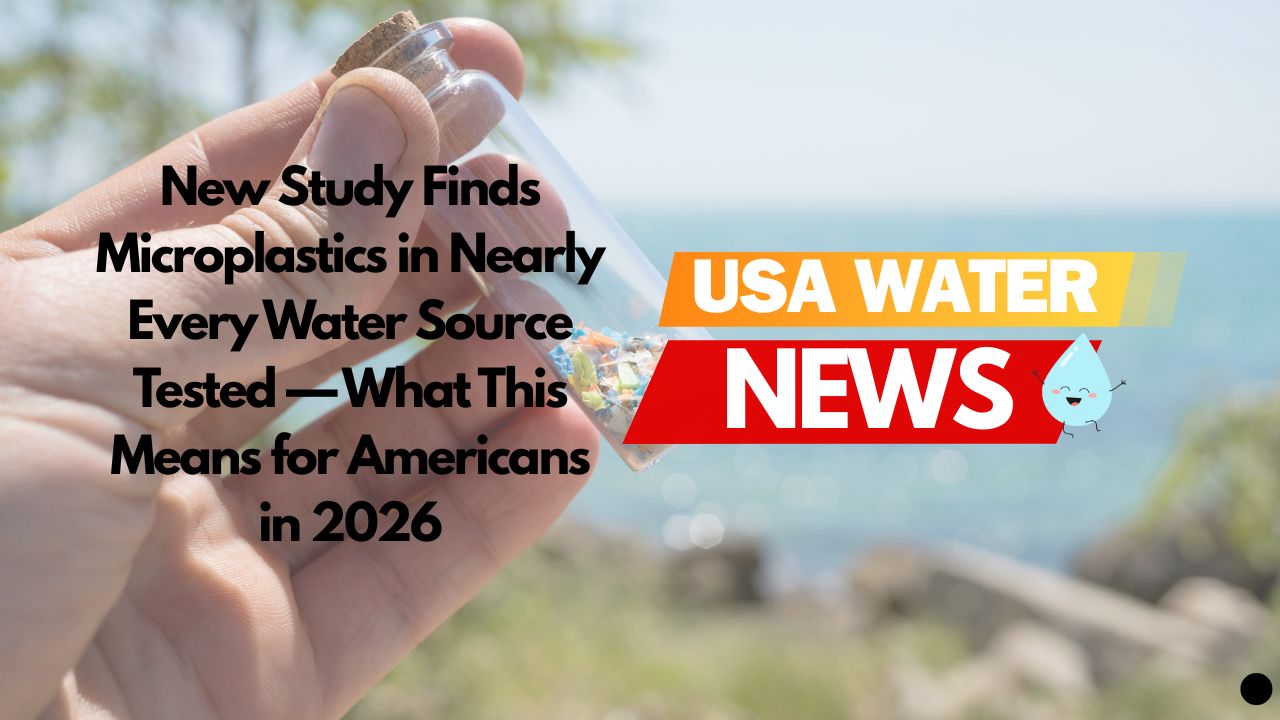
For years, scientists suspected that microplastics — tiny fragments shed from clothing, packaging, tyres, and everyday plastic products — were making their way into rivers and lakes. But new 2026 findings from multiple U.S. research groups are drawing a clearer picture than ever before: microplastics are being detected in nearly every major water source tested, from urban rivers to rural wells to the reservoirs that supply drinking water to millions of Americans.
The discovery isn’t cause for panic. Treatment plants continue to meet strict safety standards, and microplastics remain a developing area of research rather than a regulated contaminant. But the new data is raising important questions about how these particles move through the environment — and what their growing presence means for water systems already under strain from climate shifts, population growth, and aging infrastructure.
The story of microplastics in 2026 isn’t one of sudden danger.
It’s a story of a complex material quietly appearing everywhere we look.
A New Wave of Research Shows Widespread Detection
In 2025 and early 2026, university labs, state agencies, and environmental research organisations conducted expanded testing across multiple states. The goal wasn’t to assess health risk — there isn’t enough scientific consensus for that — but to understand how far these tiny particles have spread.
The answer, researchers now say, is: almost everywhere.
Microplastics were detected in:
- surface water systems feeding major cities,
- groundwater wells in agricultural regions,
- reservoirs affected by heavy rainfall,
- rivers downstream of industrial areas,
- and even in waterways flowing through protected natural landscapes.
Many of the detected particles measured less than a millimetre. Some were so small they required advanced microscopy and new filtering techniques to identify.
While quantities vary widely depending on location and season, the consistent finding is unmistakable: microplastics have become a routine part of modern water environments.
Where Are These Tiny Particles Coming From?
The path microplastics take into the environment isn’t always obvious.
Some originate from urban life — the fibres released when synthetic clothing is washed, or dust from tyre wear on busy roads. Others come from the breakdown of larger plastic items exposed to sunlight and weather. Stormwater carries these fragments into rivers and lakes. Wind blows them across fields. Floodwaters sweep them into reservoirs.
In coastal states, stronger storms and tidal surges have accelerated the movement of microplastic debris into freshwater systems. In inland regions, heavy rainfall events and flash flooding can send large pulses of runoff into streams.
None of this points to a single “problem source.”
It reflects how thoroughly plastic is woven into daily life.
Why Treatment Plants Don’t Remove All Microplastics
Modern treatment plants are designed to remove harmful microbes, sediment, metals, and chemical contaminants — not particles as small as many microplastics. Some larger microplastic fragments are captured during sedimentation or filtration. But the smallest particles can pass through conventional systems because they behave differently from traditional contaminants.
It’s not a failure of technology.
It’s that the technology was never designed for something that didn’t exist at meaningful levels when these plants were built.
The EPA currently does not regulate microplastics in drinking water, and scientific studies to understand their long-term impacts are still underway.
For now, utilities continue to meet all federal safety standards — standards that focus on known risks supported by decades of research.
What This Means for Households
Microplastics in water don’t change the taste, smell, or appearance of tap water. Most people would never know they were there without laboratory testing. Public health experts continue to emphasise that there is no evidence of acute health risks, and research is ongoing worldwide to understand their significance.
Still, the presence of microplastics has led many households to ask what they can do if they want additional peace of mind.
Home filtration systems that use advanced membranes — especially reverse osmosis systems — can reduce a wide range of extremely small particles, including some microplastics, as part of their normal operation. This is not a safety requirement, but a personal choice for those who want the most refined water possible.
A Changing Landscape for Water Research
If there’s one clear message from the new 2026 findings, it’s this: microplastics are now part of the water cycle, moving through rivers, lakes, and groundwater in ways scientists are only beginning to map.
Researchers are focusing not on fear, but on understanding:
- How these particles move through ecosystems
- How often they appear in drinking water
- Whether new treatment methods can target them
- And how stormwater and weather patterns influence their spread
Water agencies and regulators are watching these developments closely. While current evidence does not justify new regulations, the increasing presence of microplastics in the environment highlights the need for continued monitoring and research.
This is less a story about risk — and more a story about awareness, science, and the modern materials that travel further than most people realise.
CleanAirAndWater.net will continue following developments throughout 2026 and providing clear, accessible updates as new research emerges.
Sources & Notes
1. USGS – Microplastics in Freshwater Systems
https://www.usgs.gov/news/national-news-release/microplastics-freshwater-environments
2. NOAA Marine Debris Program – Microplastics Research
https://marinedebris.noaa.gov/
3. American Chemical Society – Environmental Science & Technology Microplastics Studies
https://pubs.acs.org/journal/esthag
4. EPA – Research on Emerging Contaminants (Microplastics)
https://www.epa.gov/water-research/microplastics
5. State Geological Surveys (sample regions)
California: https://www.waterboards.ca.gov/
Texas: https://www.twdb.texas.gov/
Colorado: https://dwr.colorado.gov/
(Referenced for regional sampling and study participation.)
6. National Academies of Sciences – Microplastics Workshop Summary
https://www.nationalacademies.org/
Note: This article is informational and does not provide medical or legal advice
Check your water now!
We have translated and compiled water reports on every state in the US, and covered over 100 cities. Find out how good your water is today!
Please read – our information
The information presented on cleanairandwater.net is compiled from official water quality reports, trusted news sources, government websites, and public health resources. While we strive for accuracy and thoroughness in our presentations, we are not scientists, engineers, or qualified water quality professionals.
Our mission is to present water quality information in an accessible, real-world format that helps people understand what’s in their water and make informed decisions about their health and safety. We believe that complex environmental information should be available to everyone in a format that’s easy to understand.
We make every effort to ensure our content is current and accurate, but we cannot guarantee that all information is complete or error-free. This website should not replace official communications from your local water utility or health department. We always recommend consulting official sources for the most up-to-date information regarding your specific water system.
Clean Air and Water is not liable for any unintentional errors, omissions, or outdated information. The content on this site is provided for informational purposes only and should not be considered professional advice.