← Private Well Water Directory / Rhode Island
Rhode Island Private Well Water Quality 2026
Rhode Island has over 70 legacy landfills, multiple military contamination sites, and PFAS detected in 44% of public water systems tested statewide — yet private wells remain entirely the owner’s responsibility, with no mandatory routine testing and no state notification system for well owners near contamination sites.
Rhode Island’s PFAS Problem — Smaller State, Serious Contamination
Rhode Island may be the smallest state in the union, but its PFAS contamination problem is among the most complex in New England. A comprehensive investigation by the Rhode Island Department of Environmental Management (RIDEM) identified six major categories of PFAS contamination source across the state: Department of Defense sites, Superfund sites, landfills, fire stations, wastewater treatment plants, and industrial facilities — including textile mills, a legacy of the state’s Industrial Revolution manufacturing past.
The scale of the landfill problem alone is striking. Rhode Island has over 70 closed legacy landfills scattered statewide. RIDEM’s rules from 2021 required closed landfills with monitoring programs to test for PFAS — but those rules only applied to around half of the state’s former landfills. Of those sampled, testing shows that nearly all contain PFAS in groundwater leachate that exceeds safe limits, creating plumes that spread for miles through the shallow aquifers most private wells draw from.
Military sites add significantly to the picture. Naval Station Newport — one of the most complex Superfund sites in Rhode Island — has PFAS contamination from a 2.5 million gallon partially underground fuel tank farm and associated fire suppression system. An estimated 4,800 people obtain drinking water from private wells within three miles of the site, according to EPA records. Investigators found 46 potentially contaminated sites on the base alone, of which 23 required further investigation. The former Quonset Naval Air Station and Charlestown Auxiliary Landing Field were also identified by RIDEM as major PFAS sources due to decades of fire training activity.
The most striking single documented case involved Oakland, a village in Burrillville:
- Oakland Water Association, Burrillville — a small public system supplying around 175 residents tested at up to 114 ppt PFAS. RIDEM investigators traced the most likely source to the Oakland-Mapleville Fire Station, located less than 100 yards from the water supply well. The relative proportion of PFHxS and PFOS detected — both characteristic of AFFF firefighting foam — confirmed the likely source. Over $2 million was spent extending municipal water lines to affected residents.
- Bradford Dyeing Association, Westerly and Hopkinton — a former textile mill complex where PFAS were used to make fabrics waterproof. RIDEM’s report names this as a major contamination source. PFAS groundwater contamination at the site has reached levels above 1,000 ppt, and a 2025 URI study found the mill’s retention pond sediments could continue releasing PFAS into the Pawcatuck River for more than 100 years. RIDOH advises people not to eat fish caught in the adjacent Grills Preserve Pond.
- Exeter — two water systems (Ladd Center and Carousel Industries) recorded elevated PFAS levels. RIDOH advises private well owners in the community to test as a precautionary measure, while noting there is currently no evidence that private wells in Exeter are unsafe.
- North Smithfield, Glocester, Foster and Scituate — school water systems in these communities tested above Rhode Island’s 20 ppt interim standard for PFAS. Private wells in the surrounding areas draw from the same groundwater conditions.
Rhode Island has been ahead of much of the country on PFAS regulation for public water systems. But that regulatory framework does not extend to private wells — testing and treatment of your own supply remains entirely your responsibility.
Arsenic, Beryllium and Other Geological Risks
Rhode Island’s bedrock geology creates some naturally occurring contamination risks that are specific to this region. RIDOH specifically recommends that some well owners test for both arsenic and beryllium, depending on where they live in the state. Arsenic was historically used in orchards as a pesticide, and residual contamination can persist in the soil in former agricultural areas. Beryllium occurs naturally in Rhode Island bedrock and can leach into groundwater in certain locations.
RIDOH provides an online mapping tool that allows well owners to check whether their property is in an area where arsenic or beryllium testing is recommended — a useful first step before commissioning a full laboratory panel. Both contaminants are colourless and tasteless; neither can be detected without testing.
Coastal wells in Rhode Island face an additional challenge: saltwater intrusion. In places like Block Island and other coastal South County communities, groundwater extraction combined with rising sea levels is causing brackish water to enter some wells, affecting both taste and safety. This is a documented and growing trend that will affect more coastal well owners over time.
Quick Important Advertisement – Boil Water Alerts continue below
Don’t Wait for the Next Emergency to Act
Boil water alerts are a warning sign. Whether caused by pipe breaks, contamination, or natural disasters, they highlight how vulnerable our water systems can be.
The safest long-term solution? A reliable home water filtration system designed to remove bacteria, parasites, and harmful chemicals — so you’re protected even when advisories are issued.
Stay Ready with Trusted Filtration:
✅ Removes pathogens, chlorine, PFAS, and heavy metals
✅ Safer than boiling alone — no need to wait for alerts
✅ Easy options for homes, renters, and families
Prefer no installation? Check out the A2 Countertop System
Note: This advert may contain affiliate links. If you choose to buy, we may receive a small commission — thank you for supporting our work!
Nitrate, Bacteria and Other Well Risks
Agricultural activities and failing septic systems contribute to elevated nitrate levels in groundwater across Rhode Island’s rural areas. Nitrate is a particular risk for infants under six months and for pregnant women. In communities like Scituate and Charlestown — which have the highest private well water withdrawals in the state according to USGS data — the combination of dense private well use and onsite wastewater systems creates ongoing pressure on groundwater quality.
Coliform bacteria and E. coli contamination can enter private wells through flooding, damaged wellheads, or proximity to failing septic systems. RIDEM notes that Rhode Island’s groundwater resources are “considered vulnerable to contamination because of the generally shallow depth to groundwater, aquifer permeability and the absence of subsurface confining layers” — meaning contaminants from the surface can reach private wells more readily than in states with deeper aquifer systems.
Rhode Island’s Regulatory Approach — Proactive on Public Systems, Silent on Private Wells
For public water systems, Rhode Island has taken a notably proactive stance. Effective September 18, 2024, the state set an enforceable MCL of 20 parts per trillion (ppt) for six PFAS chemicals — making Rhode Island one of a small number of states with its own binding PFAS drinking water standard. The six regulated compounds are PFOA, PFOS, PFHxS, PFNA, PFHpA, and PFDA. Public systems with PFAS above 20 ppt must enter a Consent Agreement with RIDOH and take steps to reduce levels. Systems above 70 ppt must issue a do-not-drink advisory.
None of this applies to private wells. Private residential wells in Rhode Island are not regulated under the federal Safe Drinking Water Act or the state’s public drinking water rules. There is no requirement for routine testing, no state notification system for well owners near contamination sites, and no authority for RIDOH to mandate remediation of a private well. The only mandatory testing moments under Rhode Island law are when a new well is drilled and when a home with a well is sold or transferred.
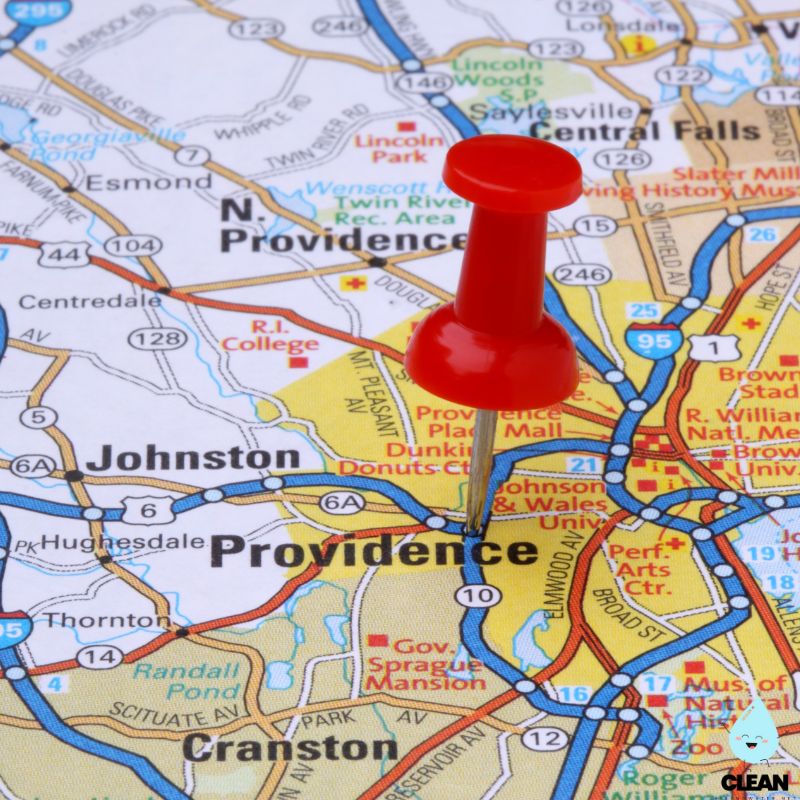
Check our Rhode Island municipal water quality page for city-by-city tap water data including Providence, or use our live boil water notice tracker for active advisories across the state.
Known High-Risk Areas in Rhode Island
If you live near any of the following locations, well water testing is urgent — not precautionary.
Oakland, Burrillville
The Oakland Water Association tested at up to 114 ppt PFAS. RIDEM investigators identified the Oakland-Mapleville Fire Station, less than 100 yards from the supply well, as the most likely source — confirmed by the high proportion of PFHxS and PFOS typical of AFFF foam. Over $2 million was spent extending municipal water to affected residents.
Naval Station Newport
One of Rhode Island’s most complex Superfund sites. PFAS contamination stems from a 2.5 million gallon underground fuel tank farm and fire suppression system. The EPA records approximately 4,800 people with private wells within three miles of the site. Investigators identified 46 potentially contaminated areas on the base, with 23 requiring further investigation.
Quonset Point, North Kingstown
The former Quonset Naval Air Station used firefighting foam for decades. PFAS contamination was discovered in 2014 in groundwater, soil, and nearby private wells. Named by Rhode Island’s Attorney General in the 2023 lawsuit against PFAS manufacturers. Camp Fogarty is also cited as a contamination source in the same legal complaint.
Bradford Dyeing Association, Westerly
A former textile mill that used PFAS to waterproof fabrics. Groundwater contamination has reached levels above 1,000 ppt on site. A 2025 URI study found mill retention pond sediments could continue releasing PFAS into the Pawcatuck River for over 100 years. RIDOH advises against eating fish from the adjacent Grills Preserve Pond.
Central Landfill, Johnston
A Superfund site that accepted liquid industrial waste in unlined areas during the 1970s. One of the six major PFAS contamination categories identified in RIDEM’s statewide report. Also named alongside Rose Hill Regional Landfill in South Kingstown and Landfill Resource and Recovery in North Smithfield.
Exeter, North Smithfield, Glocester & Foster
RIDOH advises private well owners in Exeter to test for PFAS following elevated readings at two public water systems. School water systems in North Smithfield, Glocester, Foster and Scituate have tested above Rhode Island’s 20 ppt PFAS standard. Private wells in these areas draw from the same affected groundwater.
How to Test Your Rhode Island Well Water — and What to Do Next
RIDOH recommends that all private well owners in Rhode Island test their water regularly — annually for bacteria and nitrate, and at least once for PFAS regardless of location. Given the statewide spread of legacy landfill plumes, fire station contamination, military site leachate and textile mill pollution, no area of Rhode Island can be considered low-risk for PFAS without testing.
The RIDOH Private Well Program (401-222-6867 / DOH.RIDWQ@health.ri.gov) can advise on certified laboratories, guide you through PFAS-specific sampling protocols — which require special precautions to avoid sample contamination from everyday products like permanent markers or clothing — and advise on next steps if results come back elevated. The URI Water Quality Program can also provide community support for well owners statewide.
For filter options, our well water filter guide covers reverse osmosis systems for PFAS, UV disinfection for bacteria, and whole-house well systems for comprehensive treatment. You can also browse our full water filter solutions page or check your ZIP code for local water quality context.
For other Northeast well water risks, see our pages on Maine wells, New Hampshire wells, and North Carolina wells. Return to the private well water directory to find your state.
Quality News About Your Water
Get the comprehensive water quality news coverage you need with our dedicated US Water News Service. From coast to coast, we deliver in-depth reporting and expert analysis on PFAS contamination, EPA regulatory changes, infrastructure developments, and emerging water safety issues affecting communities nationwide. While mainstream media only covers the biggest stories, we provide the detailed, ongoing coverage that helps you understand the full scope of America’s water challenges.
What’s actually in your tap water? Enter your ZIP code for a full breakdown of contaminants detected in your local supply
Drinking water from a well? Check our directory here for more information
Please read – our information
The information presented on cleanairandwater.net is compiled from official water quality reports, trusted news sources, government websites, and public health resources. While we strive for accuracy and thoroughness in our presentations, we are not scientists, engineers, or qualified water quality professionals.
Our mission is to present water quality information in an accessible, real-world format that helps people understand what’s in their water and make informed decisions about their health and safety. We believe that complex environmental information should be available to everyone in a format that’s easy to understand.
We make every effort to ensure our content is current and accurate, but we cannot guarantee that all information is complete or error-free. This website should not replace official communications from your local water utility or health department. We always recommend consulting official sources for the most up-to-date information regarding your specific water system.
Clean Air and Water is not liable for any unintentional errors, omissions, or outdated information. The content on this site is provided for informational purposes only and should not be considered professional advice.