Advertisement — New Report continues below
Concerned About Your Water Quality? You’re Not Alone.
Recent headlines and viral test results have more families questioning what’s coming out of their taps. Even if your water looks clear and tastes fine, it can still carry PFAS chemicals, chlorine byproducts, heavy metals, and other contaminants — often within legal limits, but still worth a second look.
The good news? There are trusted filtration systems designed to tackle exactly these concerns — improving water safety, taste, and peace of mind.
Smart Solutions for Safer Drinking Water:
✅ Targets harmful contaminants with advanced filtration
✅ Lab-tested and trusted for household use
✅ Options for every need — from under-sink units to full-home systems
Prefer no installation? Check out the A2 Countertop System
Disclaimer:
This advert contains affiliate links. If you buy through these links, we may earn a commission at no extra cost to you.

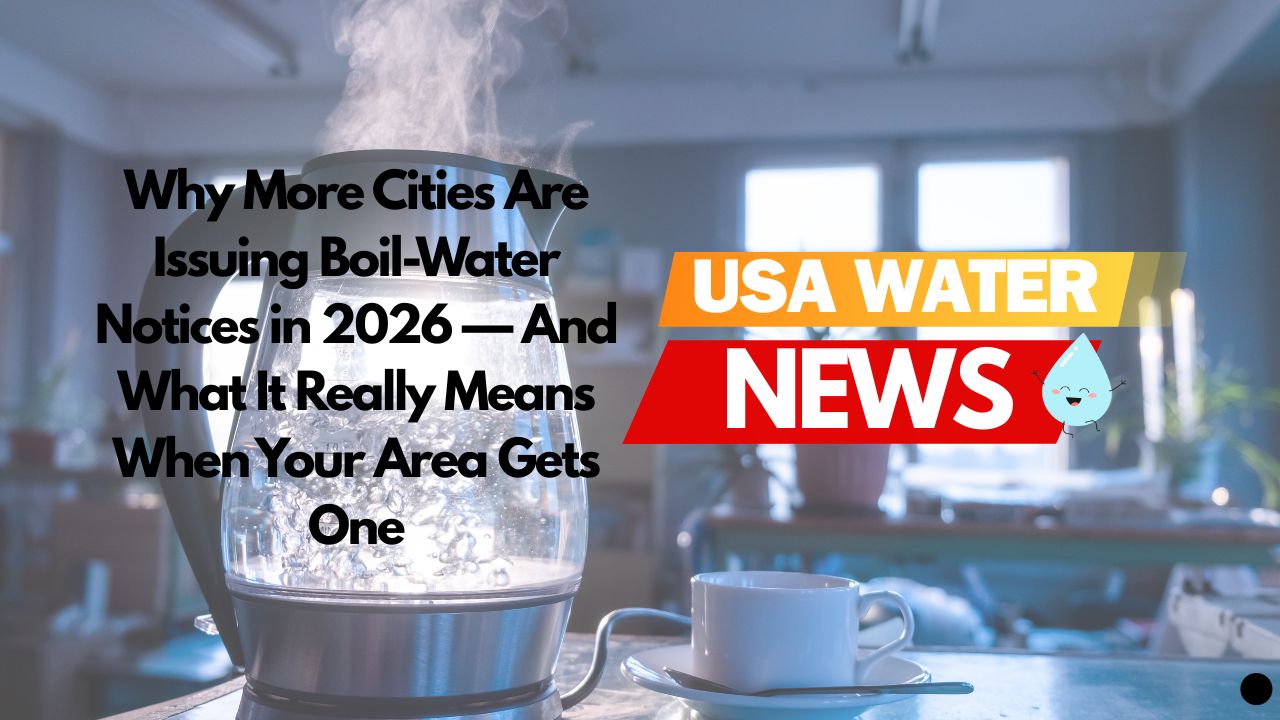
Shortly after sunrise, a mother in Ohio fills her kettle and notices the blinking alert on her phone: “Boil-Water Advisory Issued for Your Area.”
In Texas, a restaurant owner walks to the sink only to find the same warning taped to the door.
And in parts of the Southeast, residents now check local utility pages almost as routinely as checking the weather.
These moments are beginning to feel more common in 2026 — not because water quality is declining, but because utilities are becoming more proactive, more cautious, and more transparent in the way they protect public health.
Boil-water notices are a safety tool, not a sign of failure.
And the rise in advisories across parts of the U.S. says far more about weather, infrastructure, and modern communication systems than it does about the water itself.
Most people see the alert and worry immediately.
But the real story behind these notices is quieter — and far more reassuring — than many imagine.
Why You’re Seeing More Alerts — Even When Nothing Looks Wrong
Boil-water notices are issued when something might have happened that could potentially let untreated or partially untreated water enter the system. The keyword is might. Utilities often act long before any problem actually reaches a tap.
In 2026, several nationwide trends are driving a rise in advisories:
- heavier storms
- power outages from extreme weather
- rapid growth in suburban areas
- aging infrastructure that needs upgrades
- and better, faster digital alert systems
But the truth is simpler:
utilities are erring on the side of caution, and alerts that used to go unnoticed on bulletin boards now appear instantly on phones.
A problem that once took hours to detect now triggers a notice in minutes — often before the operational issue is even fully understood.
Storms Are the Biggest Trigger — and They’re Acting Differently in 2026
Modern treatment systems are designed to handle rain, but they are not designed for the kind of storm behavior that has become more common. Sudden, heavy downpours can push enormous volumes of muddy water into rivers and reservoirs. Floodwater can temporarily overwhelm intakes. Power flickers can interrupt pumps for seconds, but long enough to raise concerns.
A boil notice doesn’t mean contaminated water has entered the system.
It means that the conditions were present where it could have happened.
Utilities issue the alert, run tests, stabilise treatment, and lift the notice — often within 12–48 hours.
Aging Infrastructure Doesn’t Fail — It Just Needs More Hands-On Attention
Across the Midwest and Northeast, some pipes and valves have been in service for half a century. They don’t pose danger, but they do require more maintenance. When a pipe repair or valve replacement temporarily disrupts pressure in a district, a boil-water notice is often issued as a routine precaution.
In many cases, the water remains perfectly safe the entire time — the notice exists because pressure changes could, in theory, allow untreated water to flow backwards.
It’s less “danger” and more “we’re being extremely careful.”
Modern Communication Makes Every Notice Visible
The biggest difference between now and ten years ago isn’t the water — it’s the communication.
Before smartphones and automated alert systems, many boil notices were:
- posted on utility websites
- sent to local news
- or taped to front doors in small neighbourhoods
Most residents never saw them.
Now, alerts arrive instantly, even for tiny areas “out of an abundance of caution.”
The public sees every advisory, not only the major ones.
That visibility creates the impression of a surge — but it’s really a surge in notification, not in risk.
What a Boil-Water Notice Actually Means for Households
Despite the name, most advisories are preventive. Water operators test for bacteria, adjust treatment, flush lines, and confirm stability long before the public notices anything unusual at home.
A notice simply means:
- boil water for drinking or food prep
- use bottled water if preferred
- showering and laundry remain safe
- utilities are double-checking the system
Most advisories lift within one to two days, once water quality tests confirm everything is stable.
The water supply is monitored constantly during this period — often more intensely than usual.
2026: The Year Utilities Choose Safety First
If there’s a theme emerging this year, it’s that utilities are choosing transparency and caution over silence and assumption. Instead of waiting to see if a pressure drop, storm surge, or equipment glitch might cause an issue, they issue the advisory immediately and test afterward.
This approach protects the public, builds trust, and reflects a modern philosophy:
better one extra advisory than one missed event.
In many ways, the increase in boil-water notices is a sign that the system is working exactly as it should — not a sign that it’s failing.
The Bottom Line
Boil-water notices may feel more common in 2026, but the reasons behind them are reassuring: utilities are being more cautious, storms are more intense, and communication is faster and more transparent than ever before.
The water remains safe, continuously tested, and closely monitored — even during an advisory.
The alert is simply a reminder that water systems are living, responsive networks, shaped by weather, infrastructure, and the commitment of those who run them.
CleanAirAndWater.net will continue tracking these advisories throughout 2026, helping residents understand why they occur and what they mean for the water flowing into their homes.
Sources & Notes
USGS – Drinking Water Systems & Pressure Events
https://www.usgs.gov/mission-areas/water-resources
EPA – Boil Water Advisory Guidance
https://www.epa.gov/ground-water-and-drinking-water/boil-water-advisories
CDC – Boil Water Notices & Safety Practices
https://www.cdc.gov/healthywater/emergency/drinking/before/index.html
NOAA – Extreme Weather & Power Interruption Trends
https://www.climate.gov/
AWWA – Utility Operations & Risk Management Reports
https://www.awwa.org/
State Utility Alerts (Sample Regions)
Texas TCEQ: https://www.tceq.texas.gov/
Ohio EPA: https://epa.ohio.gov/
Note: This article is informational and does not provide medical or legal advice.
Check your water now!
We have translated and compiled water reports on every state in the US, and covered over 100 cities. Find out how good your water is today!

Please read – our information
The information presented on cleanairandwater.net is compiled from official water quality reports, trusted news sources, government websites, and public health resources. While we strive for accuracy and thoroughness in our presentations, we are not scientists, engineers, or qualified water quality professionals.
Our mission is to present water quality information in an accessible, real-world format that helps people understand what’s in their water and make informed decisions about their health and safety. We believe that complex environmental information should be available to everyone in a format that’s easy to understand.
We make every effort to ensure our content is current and accurate, but we cannot guarantee that all information is complete or error-free. This website should not replace official communications from your local water utility or health department. We always recommend consulting official sources for the most up-to-date information regarding your specific water system.
Clean Air and Water is not liable for any unintentional errors, omissions, or outdated information. The content on this site is provided for informational purposes only and should not be considered professional advice.