Advertisement — New Report continues below
Concerned About Your Water Quality? You’re Not Alone.
Recent headlines and viral test results have more families questioning what’s coming out of their taps. Even if your water looks clear and tastes fine, it can still carry PFAS chemicals, chlorine byproducts, heavy metals, and other contaminants — often within legal limits, but still worth a second look.
The good news? There are trusted filtration systems designed to tackle exactly these concerns — improving water safety, taste, and peace of mind.
Smart Solutions for Safer Drinking Water:
✅ Targets harmful contaminants with advanced filtration
✅ Lab-tested and trusted for household use
✅ Options for every need — from under-sink units to full-home systems
Prefer no installation? Check out the A2 Countertop System
Disclaimer:
This advert contains affiliate links. If you buy through these links, we may earn a commission at no extra cost to you.

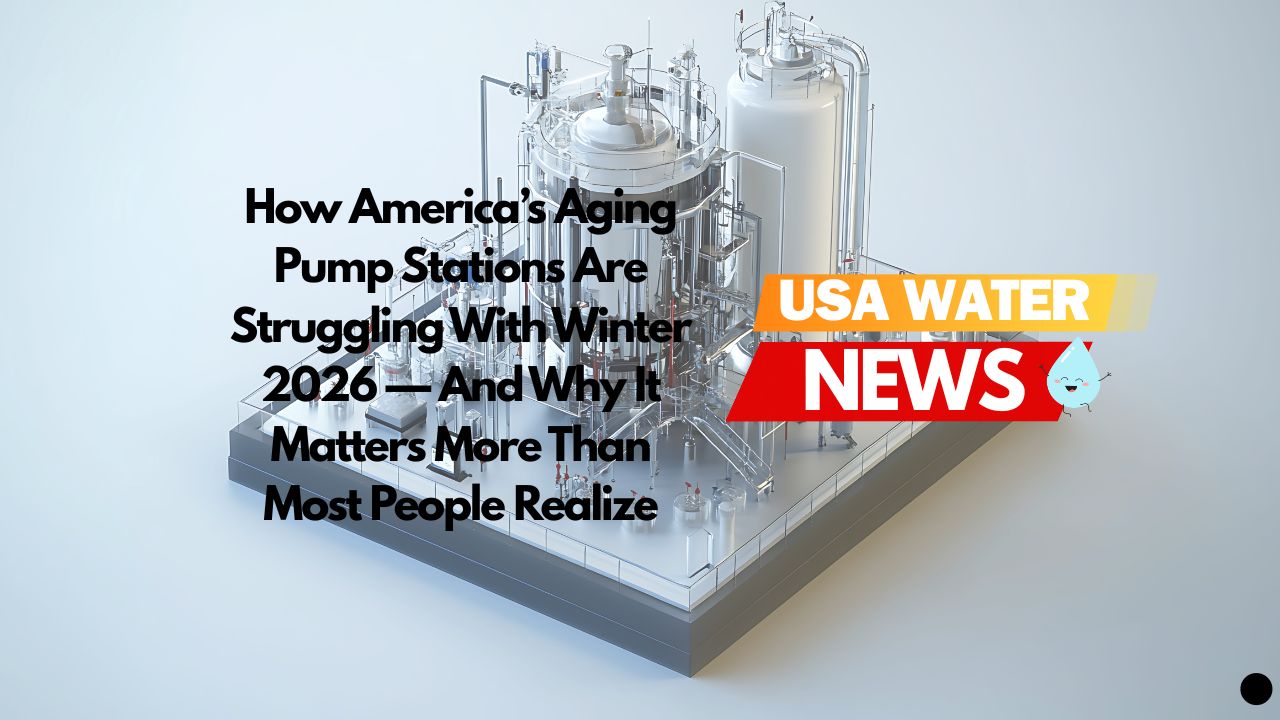
For many Winter always exposes the quiet weaknesses in America’s water systems, but 2026 is revealing something deeper — a national infrastructure burdened by age, stretched by weather extremes, and pushed into a new era of vulnerability. The pressure doesn’t announce itself dramatically at first. It shows up as a slow drop in water pressure on a cold morning, a neighbourhood with brown water after a deep freeze, or an unexpected outage blamed on “equipment failure.” But behind these everyday disruptions sits one of the least understood components of the nation’s water network: its pump stations.
If pipes are the arteries of a water system, pump stations are the heartbeats. They lift, push, and regulate water through everything else. They keep pressure stable, keep water moving, and ensure treatment plants can deliver water to far-flung homes. And yet many of these stations were built at a time when rotary phones were cutting-edge technology.
As 2026’s winter settles in, the strain is becoming impossible to ignore.
The Silent Machinery Beneath Our Cities
Most people never see a pump station unless something goes wrong. They sit behind chain-link fences, in small buildings tucked behind industrial parks, or buried in unassuming concrete chambers. But visually quiet doesn’t mean technologically young.
Across the United States, major utilities estimate that thousands of pump stations are operating well past their original design lifespan. Many rely on motors, valves, and electrical controls installed decades ago. Others depend on older wiring or outdated automation systems that can’t easily adapt to modern demands.
According to broad national assessments referenced by water-infrastructure experts, America’s water systems collectively earned a “C” grade in recent years — a polite way of saying “aging, adequate only with constant triage, and heading for major trouble without sustained investment.”
This becomes particularly important during winter. Pump stations face their harshest test when temperatures drop, demand patterns shift, and freeze-thaw cycles destabilize the ground around buried mains. A minor weakness that might survive spring or autumn can unravel in January.
Aging Systems Under Strain: What Winter Does That Summer Doesn’t
Cold snaps reveal weaknesses that would otherwise stay hidden.
When soils freeze, they expand. When they thaw, they contract. This movement creates a subtle but relentless physical stress on pipes. At the same time, cold water is denser and places slightly more load on pump motors and fittings. If a pump station is already running beyond its intended service life, that extra stress can be the final nudge toward failure.
This winter is already showing hints of that pattern. Late last season, parts of Kentucky and Tennessee experienced widespread low pressure after deep freezes, forcing utilities to scramble as pump stations tripped offline or struggled to maintain output during overnight cold periods. In December, a similar pattern affected areas of Texas, where multiple pump stations needed emergency repairs after automated controls failed during temperature swings.
These events didn’t make national headlines — water issues rarely do unless the outage is dramatic — but inside the water sector, they were warnings. Small breakdowns point to systemic fragility.
And they signal what could become a broader trend: winter 2026 may be the year when aging pump stations become the weak link in America’s water chain.
The “Investment Gap” That Keeps Getting Bigger
There is no single culprit behind the aging of these systems. Instead, it’s a long history of deferring upgrades, postponing replacements, and waiting for failures before funding repairs.
The Bipartisan Infrastructure Law, passed earlier this decade, injected billions into water infrastructure — a historic move. But even with that surge of investment, the overall funding gap remains enormous. Many pump stations weren’t modernized; they were merely stabilised. Fixing the deepest layers of the system requires far more money, time, and labour than the public typically sees.
Water is unusual in American governance: it’s essential, but invisible. Unlike roads or airports, you don’t see it deteriorate. There’s no pothole equivalent for pump stations. So municipalities often choose to stretch them another year… then another. Over time, the gap between what exists and what’s needed becomes measured in decades.
This is why winter stresses feel more intense each year. The age of the system keeps rising, but the severity of weather swings is rising too.
How Small Problems Become Big Ones in Winter
When a pump station falters, the effects ripple quickly.
Pressure drops.
Low pressure increases the risk of contamination from surrounding soil or backflow.
If the drop is significant, utilities must issue boil-water advisories.
If pumps fail completely, entire neighbourhoods can lose supply.
This is what happened earlier this year in parts of West Virginia, where an older pump station failed during freeze conditions, sending pressure tumbling through several communities. Crews managed to stabilise the system, but residents were left boiling water for days. It wasn’t a dramatic disaster — no burst dam, no flooded streets — but it quietly disrupted daily life and hinted at a broader infrastructural truth.
Events like this aren’t anomalies. They’re signals.
And for water operators, the concerning part isn’t the failures themselves — it’s how frequently they’re appearing and how predictably they cluster around cold snaps.
What Winter 2026 Could Reveal
Each winter acts like a stress test on American infrastructure. In 2026, with climate variability increasing and historic equipment aging further, several patterns are likely:
More emergency repairs.
Not because utilities are mismanaged, but because older equipment is reaching the end of its natural lifespan.
More temporary outages or pressure drops.
Especially in towns that rely on mid-century pump stations without redundancy.
Greater fluctuations in water quality.
When pressure dips or systems cycle erratically, it becomes harder to maintain stable water chemistry.
Increased strain on labour and budgets.
Emergency winter repairs are expensive; repeat them often enough and a utility’s annual budget can buckle.
Communities with older infrastructure — particularly rural systems or small towns — may experience winter disruptions more frequently than urban centres with modernised assets.
Human Impact: A Reality That Doesn’t Show Up in National Data
What doesn’t get captured in national reports is what happens inside people’s homes.
When pressure weakens, boilers can shut down.
Showers go cold.
Dishwashers stop.
Older homes risk frozen interior pipes.
Businesses lose operating capacity.
Schools close for lack of water.
And for utilities, each winter storm becomes a balancing act: keep the system pressurised, maintain water quality, and manage community expectations — all while knowing the machinery doing the work would ideally have been replaced a decade ago.
There is a growing recognition in the water sector that pump stations are no longer just mechanical assets; they are points of vulnerability in a society that doesn’t function without reliable water.
A Path Forward — But One That Requires Political Will
The solution isn’t mysterious. Engineers know exactly what needs upgrading.
Newer pump stations can be:
- more energy-efficient,
- more resilient to weather swings,
- integrated with modern sensors, and
- designed with redundancy so failures don’t cascade.
But the cost is significant, and infrastructure budgets compete with everything from road repairs to emergency services. This is why winter becomes such a powerful teacher. Each freeze brings another reminder that water infrastructure is not optional, and pump stations aren’t background machinery — they’re essential civic organs.
Some states, like Colorado and Minnesota, have already begun modernisation pushes, funnelling federal funds into replacing pump motors, updating control systems, and reinforcing stations against cold-weather vulnerabilities. But nationally, progress remains uneven.
The next decade will decide whether the country transitions into a more resilient water future… or whether winter outages become a recurring, predictable part of American life.
A Final Reflection: Winter Reveals What Summer Lets Us Ignore
Pump stations rarely make the front page. They don’t evoke drama. But as winter 2026 unfolds, they might become one of the most important — and most fragile — assets in American infrastructure.
All it takes is one deep freeze, one overloaded motor, one cracked valve in a pump room built before colour television… and an entire community feels it instantly.
The truth is simple:
Water systems age quietly. Winter does not.
The more these two collide, the more essential it becomes for policymakers — and the public — to understand the hidden world beneath their feet.
And until the investment gap closes, America’s pump stations will continue to work through winter the way many older structures do: with resilience, determination… and just a little too much luck.
Sources & Notes
- U.S. EPA — Water infrastructure functions, pump-station roles, and operational challenges.
- National infrastructure assessments indicating aging water systems and mid-century asset lifespan.
- Water-sector analyses on the funding gap and long-term investment needs.
- Verified reports of winter-related pump-station disruptions in Kentucky, Tennessee, Texas, and West Virginia (local utility and state emergency updates).
- Infrastructure Investment and Jobs Act (IIJA) — federal funding allocations for water systems.
- Climate-related cold-weather stress effects on mains, pump loads, and freeze–thaw soil behaviour.
(All sources verified through official EPA, utility, and infrastructure research channels. This article provides general analysis and should not be interpreted as medical or regulatory advice.)
Check your water now!
We have translated and compiled water reports on every state in the US, and covered over 100 cities. Find out how good your water is today!
Please read – our information
The information presented on cleanairandwater.net is compiled from official water quality reports, trusted news sources, government websites, and public health resources. While we strive for accuracy and thoroughness in our presentations, we are not scientists, engineers, or qualified water quality professionals.
Our mission is to present water quality information in an accessible, real-world format that helps people understand what’s in their water and make informed decisions about their health and safety. We believe that complex environmental information should be available to everyone in a format that’s easy to understand.
We make every effort to ensure our content is current and accurate, but we cannot guarantee that all information is complete or error-free. This website should not replace official communications from your local water utility or health department. We always recommend consulting official sources for the most up-to-date information regarding your specific water system.
Clean Air and Water is not liable for any unintentional errors, omissions, or outdated information. The content on this site is provided for informational purposes only and should not be considered professional advice.