← Private Well Water Directory / North Carolina
North Carolina Private Well Water Quality 2026
North Carolina has more private well users than almost any other state in the US — around 3.3 million residents rely on groundwater wells for their drinking water. The GenX PFAS crisis centred on Chemours’ Fayetteville Works plant has contaminated over 11,000 private wells across ten counties. With the federal GenX drinking water standard rescinded in May 2025, well owners in NC are almost entirely without regulatory protection for this contaminant.
Last reviewed: April 2026 | Sources: NC DEQ, NCDHHS, Clean Cape Fear, EPA
North Carolina’s GenX Crisis — Ground Zero for PFAS in Private Wells
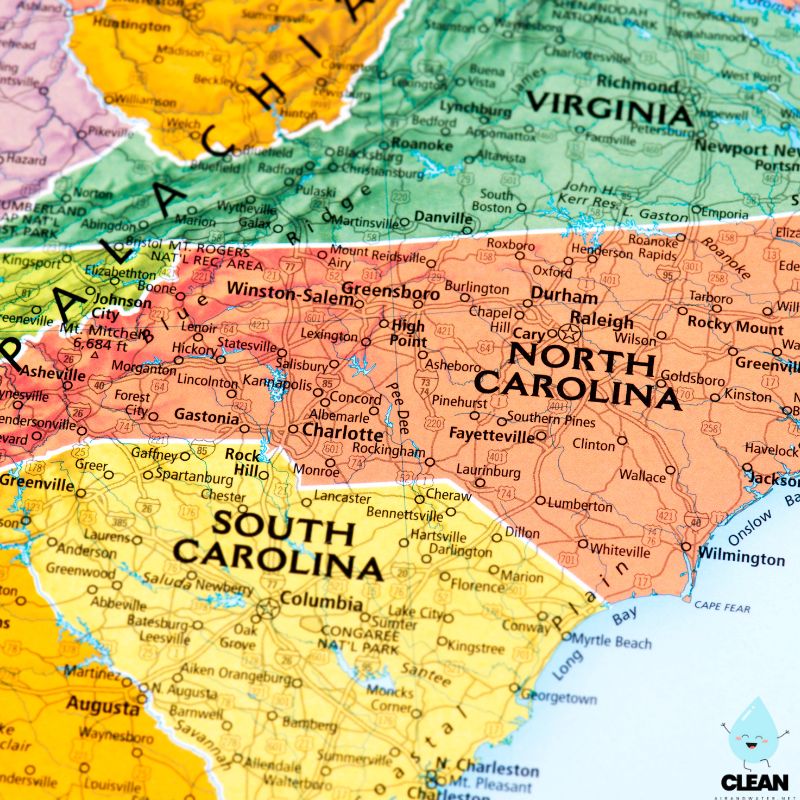
North Carolina is ground zero for one of the most significant PFAS contamination episodes in US history. The Chemours Fayetteville Works plant in Bladen County — formerly operated by DuPont since 1971 — manufactured GenX chemicals (HFPO-DA) for decades, discharging PFAS directly into the Cape Fear River and releasing them into the air and surrounding groundwater. The contamination was publicly identified in June 2017, when a toxic compound named GenX was found in the Cape Fear River — the drinking water supply for approximately 500,000 people. Evidence shows the discharges had been occurring since at least 1980.
By the time NC DEQ and Chemours completed initial well sampling, over 7,000 private drinking water wells within a 21-kilometre radius of the plant had detected PFAS contamination. As the investigation expanded to ten counties, Clean Cape Fear (2025) reports the total number of contaminated private drinking water wells now exceeds 11,000. Of the roughly 800,000 North Carolinians relying on private wells statewide, NC DEQ data indicates that a significant proportion of those in the Cape Fear region had contamination exceeding PFAS health limits — many without knowing it for years.
The contamination footprint continues to expand. In March 2025, NC DEQ directed Chemours to significantly expand well sampling eligibility, now including portions of Harnett and Hoke counties, making approximately 150,000 additional residences newly eligible for free PFAS testing — across six counties in total: Cumberland, Bladen, Robeson, Sampson, Hoke, and Harnett. In September 2025, DEQ expanded eligibility again to include additional portions of New Hanover, Brunswick, Columbus, and Pender counties — with 104,000 homes eligible for screening in those counties alone.
Well owners in the affected area who test above PFAS health thresholds may be eligible for replacement water at Chemours’ cost, under the 2019 Consent Order:
- At or above 10 ppt GenX — Granular activated carbon (GAC) whole-house system, municipal water connection, or reverse osmosis units for each sink.
- At or above 70 ppt combined PFAS — Three under-sink reverse osmosis systems, funded by Chemours.
- At or above 10 ppt for any individual PFAS — Three under-sink reverse osmosis systems.
- Bernard Allen Memorial Fund — Low-income well owners statewide may qualify for financial assistance for treatment or alternative water sources.
The contamination is not confined to the immediate Fayetteville area. NC DEQ data from landfill sites across southeastern NC has identified PFAS at multiple locations — including the closed Bladen County Landfill (where maximum GenX levels reached 7,800 ng/L — far above any health advisory threshold) and the former International Paper landfill in Columbus County, where GenX reached nearly 117 ng/L. As of August 2025, Chemours has submitted a new air permit application to expand PFAS production at the Fayetteville Works plant, which environmental groups are actively opposing.
The Regulatory Situation — GenX Federal Standard Rescinded in 2025
The regulatory picture changed significantly in 2025 and is critical for NC well owners to understand. In April 2024, the EPA established Maximum Contaminant Levels (MCLs) for six PFAS — including PFOA and PFOS at 4 ppt each, and GenX at 10 ppt. However, on May 14, 2025, the EPA announced it would rescind the MCL for GenX (HFPO-DA), PFHxS, and PFNA, and reconsider those regulatory determinations. The MCLs for PFOA and PFOS were retained, with the compliance deadline extended from 2029 to 2031.
This means there is currently no enforceable federal drinking water standard for GenX — the very chemical that defines NC’s contamination crisis. Environmental groups have called this a violation of the Safe Drinking Water Act’s anti-backsliding provision and are actively challenging the rollback. NC’s own 2L groundwater standards for PFOA, PFOS, and GenX came into effect on November 1, 2025 — but these are groundwater quality standards, not enforceable drinking water MCLs for private wells. Private well owners remain entirely outside this protection.
Check our North Carolina municipal water quality page for city-by-city tap water data, our Fayetteville water quality page for the city at the centre of the crisis, or use our live boil water notice tracker for active advisories across the state. Our full PFAS Protection Map 2026 shows how NC compares with every other state.
Quick Important Advertisement – Boil Water Alerts continue below
Don’t Wait for the Next Emergency to Act
Boil water alerts are a warning sign. Whether caused by pipe breaks, contamination, or natural disasters, they highlight how vulnerable our water systems can be.
The safest long-term solution? A reliable home water filtration system designed to remove bacteria, parasites, and harmful chemicals — so you’re protected even when advisories are issued.
Stay Ready with Trusted Filtration:
✅ Removes pathogens, chlorine, PFAS, and heavy metals
✅ Safer than boiling alone — no need to wait for alerts
✅ Easy options for homes, renters, and families
Prefer no installation? Check out the A2 Countertop System
Note: This advert may contain affiliate links. If you choose to buy, we may receive a small commission — thank you for supporting our work!
Arsenic, Manganese and Heavy Metals in NC Wells
Beyond PFAS, North Carolina well owners face documented risks from naturally occurring contaminants. NCDHHS identifies arsenic and manganese as pressing public health concerns in private wells statewide. Research in Union County, NC found that 18% of tested wells exceeded the arsenic MCL of 10 ppb, and 12% exceeded the manganese health advisory level. Arsenic is colourless and tasteless — it cannot be detected without laboratory testing — and long-term exposure is linked to bladder, kidney, and lung cancers. NCDHHS warns that many wells across the state have elevated levels of lead, arsenic, iron, manganese, low pH, and harmful bacteria.
Children dependent on unregulated private wells face a 25% increased risk of elevated blood lead levels compared to those on public water systems, according to published research. Lead can enter well water through corroded well components and plumbing — particularly in older homes — and causes no change in taste, colour, or smell.
Nitrate and Bacteria — Agricultural and Flooding Risks
North Carolina’s large agricultural sector — including one of the highest concentrations of hog farming operations (CAFOs) in the country — poses a significant nitrate contamination risk to shallow wells, particularly in eastern counties. Nitrate runoff from fertiliser application and animal waste storage is well documented across the region. High nitrate is especially dangerous for infants under six months, where it can cause blue baby syndrome — a potentially fatal condition that reduces the blood’s ability to carry oxygen.
Coliform bacteria is another documented risk, particularly following major flooding events. Hurricane Helene struck western NC in October 2024 and Hurricane Florence in 2018 both caused widespread wellhead contamination across multiple counties. NCDHHS recommends testing for bacteria every year and immediately after any flooding event, regardless of well location.
Known High-Risk Areas in North Carolina
If you live near any of the following locations, well water testing is urgent — not precautionary.
Fayetteville Area, Cumberland & Bladen Counties
The Chemours Fayetteville Works plant is the source of the GenX crisis, discharging PFAS into the Cape Fear River and groundwater since at least 1980. Free PFAS well testing: call Chemours at (910) 678-1101. See also our Fayetteville water quality page.
Lower Cape Fear — New Hanover, Brunswick, Pender, Columbus Counties
PFAS from Chemours migrated downstream into the Cape Fear River and surrounding groundwater. As of September 2025, 104,000 homes are eligible for Consent Order screening. Call Chemours at (910) 678-1100 to request free testing.
Hoke & Harnett Counties
In March 2025, NC DEQ expanded the sampling zone to these counties after modelling identified the contamination boundary. Around 150,000 additional residences became newly eligible for free testing. Call Chemours at (910) 678-1101.
Robeson & Sampson Counties
Included in the expanded Chemours sampling zone. Both counties also sit in a region with significant hog farming operations that pose additional nitrate risks to shallow wells — double contamination risk for rural well owners.
Bladen County Landfill Site
NC DEQ data found maximum GenX levels of 7,800 ng/L at the closed Bladen County Landfill — orders of magnitude above any health advisory threshold. Rural well users near landfill sites across southeastern NC face elevated PFAS groundwater risk.
Eastern NC — Agricultural Areas
Nitrate contamination from hog farm waste and fertiliser runoff is documented across eastern NC counties. Shallow wells near active agricultural land and CAFOs should be tested annually for nitrate and bacteria. Western NC wells face post-Helene bacteria risk.
Frequently Asked Questions — NC Private Well Water
Is GenX still regulated in North Carolina drinking water?
At the federal level, the EPA rescinded the GenX MCL in May 2025 — so there is currently no enforceable federal drinking water standard for GenX. North Carolina’s own 2L groundwater standard for GenX took effect on November 1, 2025, but this applies to groundwater quality, not private well drinking water directly. Private well owners have no mandatory regulatory protection for GenX and must test and filter their own water.
How do I get my NC well tested for GenX and PFAS for free?
If you are in the Fayetteville area (Cumberland, Bladen, Robeson, Sampson, Hoke, or Harnett counties), call Chemours at (910) 678-1101. If you are in the Lower Cape Fear area (New Hanover, Brunswick, Pender, or Columbus counties), call (910) 678-1100. Chemours is required under the 2019 Consent Order to fund testing and provide replacement water for qualifying households. For the rest of NC, contact your local county health department or use the NC State Lab of Public Health.
What filter removes GenX and PFAS from well water?
Reverse osmosis (RO) is the most effective treatment for PFAS including GenX. Granular activated carbon (GAC) systems can also reduce PFAS levels. Chemours is required to provide eligible well owners with either a whole-house GAC system or under-sink RO units at no cost. For well owners outside the programme, see our well water filter recommendations.
How many North Carolina wells are contaminated with PFAS?
As of 2025, Clean Cape Fear reports that over 11,000 private drinking water wells across ten counties have been found to contain PFAS contamination linked to Chemours’ Fayetteville Works plant. The contamination zone continues to expand as sampling eligibility is extended to new areas.
Should I test my NC well water even if I’m not near Fayetteville?
Yes. PFAS contamination exists at multiple sites across NC, not just near Chemours. Additionally, arsenic, manganese, bacteria, and nitrate are documented risks in wells statewide. NCDHHS recommends all private well owners test for bacteria annually and for heavy metals every two years at minimum. If you live near any landfill, military base, or agricultural area, PFAS testing is also advisable.
How to Test Your North Carolina Well Water — and What to Do Next
Every private well owner in North Carolina should test their water. PFAS, GenX, arsenic, and bacteria are all colourless and tasteless — contamination can exist at harmful levels with no detectable sign. NCDHHS recommends testing for bacteria every year, heavy metals every two years, and pesticides and volatile organic compounds every five years. If you are pregnant or have an infant at home, test for nitrates immediately.
If you are in the Cape Fear region — Cumberland, Bladen, Robeson, Sampson, Hoke, Harnett, New Hanover, Brunswick, Pender, or Columbus counties — contact Chemours directly to request free PFAS well sampling. You can also contact NC DEQ’s Division of Waste Management at (919) 707-8200 for help reading your results and accessing treatment options under the Consent Order.
For the rest of the state, contact your local county health department to arrange testing via the NC State Lab of Public Health, or use a state-certified private laboratory. NCDHHS maintains a certified lab list at epi.dph.ncdhhs.gov.
For filter options, our well water filter guide covers reverse osmosis systems for PFAS and arsenic, UV disinfection for bacteria, and whole-house well systems for comprehensive treatment. Browse our full water filter solutions page or check your ZIP code for local water quality context.
For NC city-level water quality data, see our pages on Charlotte, Raleigh, Fayetteville, and North Carolina statewide tap water quality. Return to the private well water directory to find your state, or see the Michigan well water guide for another state with a serious PFAS well crisis.
Quality News About Your Water
Get the comprehensive water quality news coverage you need with our dedicated US Water News Service. From coast to coast, we deliver in-depth reporting and expert analysis on PFAS contamination, EPA regulatory changes, infrastructure developments, and emerging water safety issues affecting communities nationwide. While mainstream media only covers the biggest stories, we provide the detailed, ongoing coverage that helps you understand the full scope of America’s water challenges. Whether you’re a concerned citizen, water professional, or community leader, our daily updates and analytical insights keep you informed about the issues that matter most to public health and environmental safety.
What’s actually in your tap water? Enter your ZIP code for a full breakdown of contaminants detected in your local supply
Please read – our information
The information presented on cleanairandwater.net is compiled from official water quality reports, trusted news sources, government websites, and public health resources. While we strive for accuracy and thoroughness in our presentations, we are not scientists, engineers, or qualified water quality professionals.
Our mission is to present water quality information in an accessible, real-world format that helps people understand what’s in their water and make informed decisions about their health and safety. We believe that complex environmental information should be available to everyone in a format that’s easy to understand.
We make every effort to ensure our content is current and accurate, but we cannot guarantee that all information is complete or error-free. This website should not replace official communications from your local water utility or health department. We always recommend consulting official sources for the most up-to-date information regarding your specific water system.
Clean Air and Water is not liable for any unintentional errors, omissions, or outdated information. The content on this site is provided for informational purposes only and should not be considered professional advice.