← Private Well Water Directory / Oklahoma
Oklahoma Private Well Water Quality 2026
Oklahoma has 12 confirmed military PFAS contamination sites, an unregulated private well sector, and a major central aquifer with documented arsenic, nitrate, and chromium contamination. With no state PFAS limits and no mandatory well testing, Oklahoma residents face serious untested drinking water risks — and most have no idea.
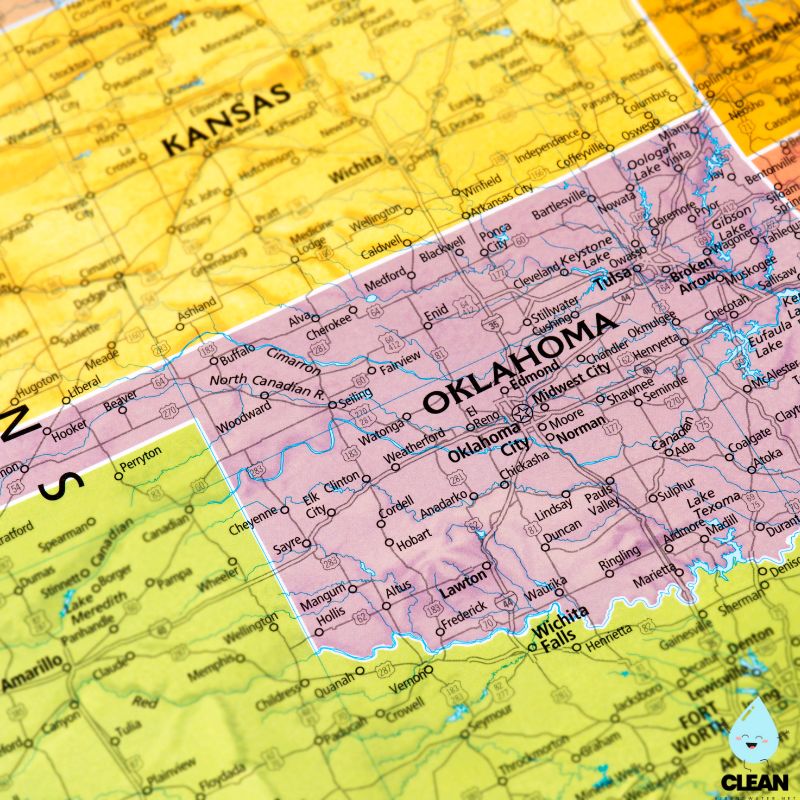
PFAS Contamination in Oklahoma Well Water
Oklahoma has 12 confirmed military PFAS contamination sites and at least 9 public water systems where PFAS levels above EPA limits have been detected. The primary source of PFAS in Oklahoma groundwater is the military’s decades-long use of Aqueous Film Forming Foam (AFFF) at air force bases and training facilities. These chemicals do not break down — they migrate through soil and into aquifers, reaching private wells in surrounding communities.
Tinker Air Force Base near Oklahoma City is Oklahoma’s most significant known PFAS contamination source for private wells. The Air Force Civil Engineer Center sampled 105 private wells around the base and initially identified six wells with PFOS and PFOA above EPA acceptable levels — with a seventh confirmed subsequently. The Air Force provided bottled water to those residents, but many families went without a long-term solution for close to two years. On-base groundwater contamination at Tinker is severe, with PFAS recorded at levels far exceeding the EPA’s 4 ppt limit; the base is listed as a Superfund site under the EPA’s CERCLA programme.
Oklahoma’s other heavily contaminated military sites include Altus Air Force Base, Vance Air Force Base, and the Air National Guard Base at Tulsa International Airport. On-base groundwater concentrations at these sites — which are separate from private well readings and represent contamination within or immediately beneath the installations themselves — are among the highest recorded at any US military base. EWG data from 2017 recorded on-base groundwater at Altus at 1,150,000 ppt, Vance at 329,000 ppt, and the Tulsa ANG Base at 69,000 ppt. The risk for surrounding private well owners comes from PFAS plumes migrating off-base through groundwater. Fort Sill and McAlester Army Ammunition Plant are also included in EPA and DoD joint programmes testing private drinking water wells near Army installations for PFAS. As of February 2026, EPA Region 6 was still conducting PFAS testing at private wells near Oklahoma military installations.
For public water systems, the picture is also concerning. In Bethany, testing in 2015 recorded 103 ppt of PFAS in water sourced from an old military site — the city stopped using the affected well after the discovery. In Edmond, the Lake Arcadia water source exceeded the EPA’s PFOS limit of 4 ppt in 2024, testing at 6.4 ppt. Nowata and Broken Arrow have also been identified as locations where PFAS exceeded proposed limits.
Oklahoma does not have its own state PFAS maximum contaminant levels. Testing for PFAS in public water systems was, until recently, not a requirement in the state. Two bills that would have required more testing and public notification failed to pass the Oklahoma Legislature. As a result, most public systems in the state never tested — and private wells remain entirely unmonitored.
The Garber-Wellington Aquifer: Arsenic, Nitrate, and Chromium
Separate from military PFAS contamination, Oklahoma’s Garber-Wellington Aquifer — also known as the Central Oklahoma Aquifer — presents a significant and well-documented natural contamination risk. The aquifer underlies approximately 2,890 square miles of central Oklahoma and is one of the most important drinking water sources in the state, used extensively for municipal, domestic, and agricultural purposes.
Arsenic, chromium, and selenium occur naturally in the aquifer’s geology and have been detected at concentrations that exceed EPA primary drinking water standards in parts of the aquifer. In deep wells, arsenic and chromium concentrations are particularly elevated. USGS research conducted in cooperation with Oklahoma DEQ found that 13 percent of shallow domestic wells in a 2003–2005 study exceeded the nitrate nitrogen MCL of 10 mg/L, and arsenic was frequently detected — though at lower concentrations in shallow wells than in deeper ones. Uranium has also been recorded at uncommonly high levels in parts of the aquifer.
The quality of water from shallow domestic wells in this aquifer is not monitored by the state. Residents with wells drawing from the Garber-Wellington system may be unknowingly consuming water with nitrate, arsenic, chromium, selenium, and other contaminants at concentrations considered harmful — with no notification system in place.
Quick Important Advertisement – Boil Water Alerts continue below
Don’t Wait for the Next Emergency to Act
Boil water alerts are a warning sign. Whether caused by pipe breaks, contamination, or natural disasters, they highlight how vulnerable our water systems can be.
The safest long-term solution? A reliable home water filtration system designed to remove bacteria, parasites, and harmful chemicals — so you’re protected even when advisories are issued.
Stay Ready with Trusted Filtration:
✅ Removes pathogens, chlorine, PFAS, and heavy metals
✅ Safer than boiling alone — no need to wait for alerts
✅ Easy options for homes, renters, and families
Prefer no installation? Check out the A2 Countertop System
Note: This advert may contain affiliate links. If you choose to buy, we may receive a small commission — thank you for supporting our work!
Nitrate, Bacteria, and Oil & Gas Contamination
Nitrate contamination from agricultural fertiliser runoff is a documented risk for shallow wells across Oklahoma, particularly in the western and central parts of the state. The Ogallala Aquifer region in the Oklahoma Panhandle is especially susceptible to nitrate from intensive farming. High nitrate levels are acutely dangerous for infants under six months, and present longer-term health risks with chronic exposure.
Oklahoma also faces a contamination risk unique to the state: the proximity of oil and gas operations to private wells. Over 900 earthquakes were recorded in Oklahoma in 2024 alone, largely linked to wastewater injection from oil and gas extraction. Seismic activity can damage well casings, creating pathways for surface and subsurface contaminants to enter groundwater. Oklahoma also has a significant legacy of improperly abandoned oil and gas wells that can act as direct conduits for contamination of drinking water aquifers.
Coliform bacteria contamination remains a risk for any well where the casing is compromised, the wellhead is improperly sealed, or where flooding occurs. Oklahoma’s recurring severe weather — including tornadoes and flash flooding — increases the risk of surface water entering wells.
Regulatory Situation for Oklahoma Well Owners
Neither federal nor state government regulates privately owned drinking water wells in Oklahoma. The Oklahoma Department of Environmental Quality (ODEQ) and the Oklahoma Water Resources Board (OWRB) have no legal authority to mandate testing or monitoring of private wells. The OWRB recommends annual testing for total coliform bacteria, nitrate, conductivity, and pH, and advises testing at least once for PFAS, arsenic, and other contaminants — but these are recommendations only, not requirements.
Oklahoma has no state PFAS maximum contaminant levels. The federal EPA MCLs of 4 ppt for PFOA and PFOS — set in April 2024 — apply only to public water systems, not private wells. Testing and treatment of your well is entirely your responsibility. Oklahoma does not require a state permit for domestic household wells, meaning there is no formal registration or inspection process that would identify contamination risks.
Check our Oklahoma municipal water quality page for city-by-city tap water data, or see our Oklahoma City water quality page for the capital. Use our live boil water notice tracker for active advisories across the state.
Known High-Risk Areas in Oklahoma
If you live near any of the following locations, well water testing is urgent — not precautionary.
Tinker Air Force Base, Oklahoma City Area
Six private wells around the base initially confirmed above EPA PFAS limits (a seventh subsequently identified). The Air Force sampled 105 surrounding wells and provided bottled water to affected households. Tinker is listed as a Superfund site due to on-base PFAS contamination from decades of AFFF use.
Altus Air Force Base, Jackson County
On-base groundwater recorded at 1,150,000 ppt (EWG/DoD 2017 data) — among the highest concentrations at any US military installation. Surrounding rural communities rely heavily on private wells and are at risk from off-base PFAS plume migration.
Vance Air Force Base, Enid Area
On-base groundwater recorded at 329,000 ppt (EWG/DoD 2017 data). The Air Force has stated that testing of off-base drinking water wells in the immediate area found no leakage into local groundwater, but ongoing monitoring continues and well owners in the vicinity should test independently.
Tulsa International Airport, Tulsa County
Air National Guard Base at Tulsa International Airport recorded 69,000 ppt in on-base groundwater (EWG/DoD 2017 data). PFAS also detected in the Tar Creek River, which flows downstream into Grand Lake O’ the Cherokees — a regional water source.
Central Oklahoma — Garber-Wellington Aquifer
Arsenic, chromium, selenium, and uranium occur at elevated levels throughout this aquifer, which underlies approximately 2,890 square miles of central Oklahoma. Residents with domestic wells in Oklahoma, Logan, Cleveland, and surrounding counties should test for these contaminants.
Fort Sill & McAlester Army Ammunition Plant
Both facilities are included in the EPA and DoD joint programme testing private drinking water wells near Army installations for PFAS. Testing was ongoing as of early 2026. Well owners in surrounding communities should request testing information from ODEQ.
How to Test Your Oklahoma Well Water — and What to Do Next
Given Oklahoma’s contamination profile — PFAS from military sites, naturally occurring arsenic and chromium in the central aquifer, nitrate from agriculture, and bacteria risk from seismic damage — every private well owner in the state should test their water. PFAS is colourless, odourless, and tasteless. The contaminants in the Garber-Wellington Aquifer are equally undetectable without laboratory testing. The only way to know if your water is safe is to test it.
Oklahoma State University Extension offers free well water screening events at county Extension offices — contact (405) 744-6630 or your county Extension office for details. For official bacteria and arsenic tests, use an ODEQ-accredited laboratory — contact Oklahoma DEQ at (405) 702-0100 for a certified lab list. If you are near a military base or airport, request PFAS-specific testing from your county health department or ODEQ directly.
For filter options, our well water filter guide covers reverse osmosis systems for PFAS, arsenic, and nitrate, UV disinfection for bacteria, and whole-house well systems for comprehensive treatment. You can also browse our full water filter solutions page or check your ZIP code for local water quality context.
For well water risks in neighbouring states, see our page on Michigan private well water. Return to the private well water directory to find your state.
Quick Important Advertisement – Boil Water Alerts continue below
Don’t Wait for the Next Emergency to Act
Boil water alerts are a warning sign. Whether caused by pipe breaks, contamination, or natural disasters, they highlight how vulnerable our water systems can be.
The safest long-term solution? A reliable home water filtration system designed to remove bacteria, parasites, and harmful chemicals — so you’re protected even when advisories are issued.
Stay Ready with Trusted Filtration:
✅ Removes pathogens, chlorine, PFAS, and heavy metals
✅ Safer than boiling alone — no need to wait for alerts
✅ Easy options for homes, renters, and families
Prefer no installation? Check out the A2 Countertop System
Note: This advert may contain affiliate links. If you choose to buy, we may receive a small commission — thank you for supporting our work!
Quality News About Your Water
Get the comprehensive water quality news coverage you need with our dedicated US Water News Service. From coast to coast, we deliver in-depth reporting and expert analysis on PFAS contamination, EPA regulatory changes, infrastructure developments, and emerging water safety issues affecting communities nationwide. While mainstream media only covers the biggest stories, we provide the detailed, ongoing coverage that helps you understand the full scope of America’s water challenges.
What’s actually in your tap water? Enter your ZIP code for a full breakdown of contaminants detected in your local supply
Drinking water from a well? Check our directory here for more information
Please read – our information
The information presented on cleanairandwater.net is compiled from official water quality reports, trusted news sources, government websites, and public health resources. While we strive for accuracy and thoroughness in our presentations, we are not scientists, engineers, or qualified water quality professionals.
Our mission is to present water quality information in an accessible, real-world format that helps people understand what’s in their water and make informed decisions about their health and safety. We believe that complex environmental information should be available to everyone in a format that’s easy to understand.
We make every effort to ensure our content is current and accurate, but we cannot guarantee that all information is complete or error-free. This website should not replace official communications from your local water utility or health department. We always recommend consulting official sources for the most up-to-date information regarding your specific water system.
Clean Air and Water is not liable for any unintentional errors, omissions, or outdated information. The content on this site is provided for informational purposes only and should not be considered professional advice.