← Private Well Water Directory / Nevada
Nevada Private Well Water Quality 2026
Nevada is the driest state in the nation — and for the 250,000 Nevadans relying on private wells, that geology comes with a serious price. Research by the Desert Research Institute found that 22% of Northern Nevada domestic wells exceed the EPA arsenic limit, with some samples reaching 80 times the federal threshold. In Nevada, zero government agency is required to test or regulate your well water. Testing and treatment is entirely your responsibility.
Nevada’s Geology Is the Problem — and It’s Everywhere
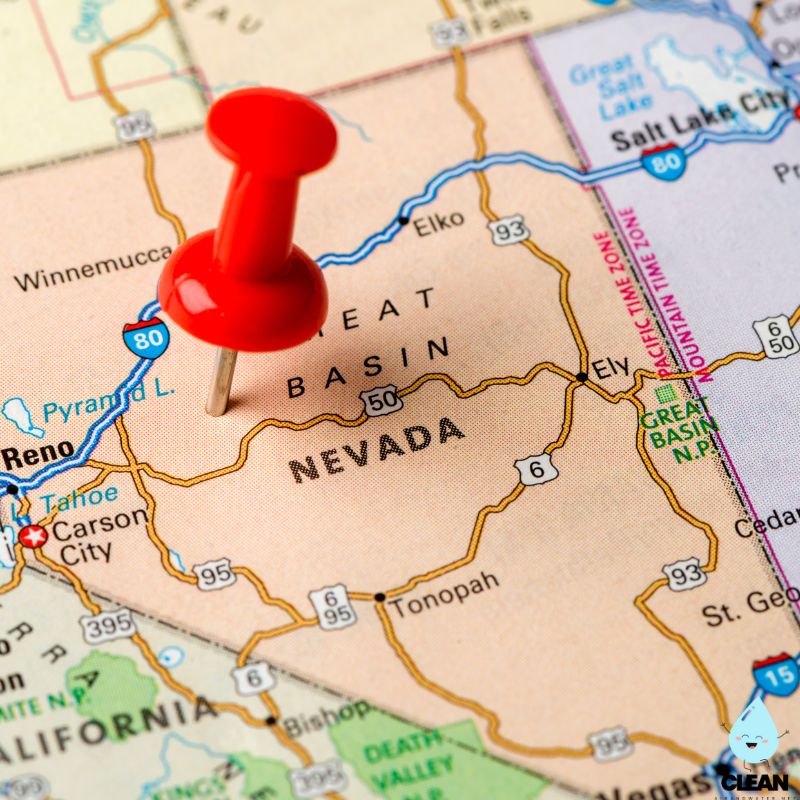
Unlike many states where well water contamination is driven primarily by industrial pollution, Nevada’s most serious well water risks are largely geological in origin. The state sits in the Basin and Range Province — a region of intense tectonic stretching that has created a complex network of fault zones, geothermal systems, and basin-fill aquifers. This geology drives arsenic, uranium, and other heavy metals into groundwater at concentrations that in many cases far exceed what is considered safe to drink.
The Desert Research Institute (DRI), in collaboration with the Healthy Nevada Project, conducted the most comprehensive study of Nevada private well water to date, sampling 174 domestic wells across the state. The findings were stark: 22% of wells had arsenic concentrations exceeding the EPA’s maximum contaminant level of 10 µg/L. The maximum arsenic concentration observed was approximately 80 times the EPA limit. Uranium (at 5 times the guideline), iron, lithium, manganese, and molybdenum were also found above federal or health-based thresholds in a significant proportion of wells tested.
Critically, the study also found that even among the 41% of households that already had a water treatment system installed, some were still drinking water above guideline values. The problem is not simply a lack of treatment — it is that many treatment systems in Nevada are underpowered for the geology, incorrectly sized, or poorly maintained. Arsenic above 800 µg/L (the maximum recorded in the Carson area near Fallon in earlier USGS surveys) will defeat most standard residential filters.
The 2023 DRI predictive modelling study, published in Environmental Science and Technology, extended this analysis across the western Great Basin using tectonic, geothermal, and hydrologic variables. The model found that approximately 49,000 domestic well users across northern Nevada, northeastern California, and western Utah face a greater than 50% probability of elevated arsenic in their untreated well water. The highest-risk populations are concentrated in the Carson Desert basin around Fallon, Carson Valley (Minden and Gardnerville), and the Truckee Meadows (Reno).
PFAS Contamination Near Nevada Military Installations
While Nevada’s municipal water systems have largely tested below detectable limits for PFAS through EPA UCMR5 monitoring (2023–2025), private wells near military installations face a different picture. Nellis Air Force Base, located north of Las Vegas, has documented PFAS in on-base groundwater monitoring at 47,400 ppt PFOA+PFOS — a level far exceeding the federal MCL of 4 ppt for each compound individually. This is base groundwater, not the Southern Nevada Water Authority’s treated municipal supply. However, private well owners in unincorporated areas near Nellis should test for PFAS as a precautionary measure.
In Northern Nevada, PFAS contamination has been confirmed in Swan Lake and in soil and groundwater near a former fire training academy (the former Dodd/Beals Firefighting Academy, located on land donated by Stead Air Force Base) in the Lemmon Valley area north of Reno. The City of Reno confirmed in its own sampling that all drinking water well samples in the area were non-detect for PFAS — the municipal supply via TMWA is not affected. However, the Lemmon Valley basin had over 1,800 registered domestic wells as of 2015, and environmental scientists have flagged the potential for private well contamination as the groundwater plume below the former fire training site is investigated further. NDEP has confirmed it is conducting additional sampling. For Lemmon Valley private well owners, testing is a prudent precaution while investigation is ongoing. Fallon Naval Air Station (NAS Fallon) — already associated with elevated arsenic and radioactivity in surrounding wells — has the most severe documented PFAS contamination of any installation in Nevada. Navy testing found groundwater on the base at 1,038,000 ppt PFOA+PFOS combined — nearly 15,000 times the previous EPA health advisory of 70 ppt. The Agency for Toxic Substances and Disease Registry (ATSDR) has assessed that contamination is currently confined to the shallow aquifer beneath the base, and that private wells in surrounding communities generally draw from the deeper intermediate aquifer. No confirmed off-base private well contamination from NAS Fallon has been reported to date — but given the scale of on-base contamination and the arid, slow-moving groundwater conditions of Churchill County, the precautionary recommendation for any private well owner within 10 miles of the base is to test for PFAS.
In November 2024, the Nevada Board of Examiners approved an NDEP contract to conduct PFAS sampling at all public water systems statewide — a significant step. However, this programme covers public water systems only. Private wells remain entirely outside its scope. NDEP has confirmed it has not identified any industries in Nevada that manufactured PFAS, meaning industrial plume contamination is less of a concern here than in states like Michigan — but military-source PFAS near bases is a documented and significant risk.
Nitrate, Radioactivity, and Bacteria Risks
Nitrate contamination is a documented risk in Nevada’s irrigated agricultural valleys, particularly Pahrump Valley (Nye County) and Snake/Carson Valley. Nitrate enters groundwater from fertiliser application and in some areas from septic systems. The EPA MCL is 10 mg/L; Nevada health officials warn against using well water above this threshold, particularly for infants under six months, for whom nitrate poses a risk of methemoglobinemia (blue baby syndrome).
Radioactivity is a less-discussed but real concern in parts of Nevada. A USGS study of 92 private domestic wells in the Lahontan Valley near Fallon found that 11 of 63 deeper wells (those greater than 50 feet) had radioactivity exceeding federal drinking water standards — primarily from uranium decay products including polonium-210. University of Nevada Cooperative Extension recommends testing for any well owner in the Fallon area and notes that reverse osmosis is the most effective treatment for uranium reduction.
Bacterial contamination — from coliform and E. coli — is a risk in older, improperly sealed wells and in areas where septic systems are sited too close to well casings. This risk is more acute after heavy rainfall or flooding events. Nevada’s arid climate means flooding is less common, but when it occurs it is often intense, and post-flood testing of any private well is strongly recommended.
The Regulatory Situation for Nevada Well Owners
Private wells in Nevada are not regulated under the Safe Drinking Water Act or its Nevada equivalent. The Nevada Division of Environmental Protection (NDEP) has explicitly stated it has no authority to regulate the water quality of private wells. There is no mandatory testing, no notification system, and no government body responsible for monitoring what comes out of your tap if you are on a domestic well. The Nevada Division of Water Resources manages well permits and drilling standards — but this covers well construction, not ongoing water quality.
NDEP does provide a list of certified laboratories for private well testing, and the Nevada State Health Laboratory in Reno can process samples. University of Nevada Cooperative Extension offices provide guidance on testing, sampling procedures, and treatment recommendations. But the responsibility — and the cost — of testing and treating your well water falls entirely on you as the well owner.
For Nevada’s municipal water quality, see our Nevada state water quality page, our Las Vegas tap water report, our Reno water quality page, and our North Las Vegas water quality page. You can also check our live boil water notice tracker for any active advisories in Nevada.
Known High-Risk Areas in Nevada
If you live near any of the following locations, well water testing is urgent — not precautionary.
Fallon / Churchill County
Some of the highest documented arsenic in Nevada groundwater — USGS data compiled in the DRI 2023 study recorded concentrations in the Carson Basin/Fallon area as high as 2,408 µg/L, over 240 times the EPA limit of 10 µg/L. Also elevated uranium and radioactivity in deeper wells (>50 ft). NAS Fallon has confirmed PFAS in on-base groundwater at 1,038,000 ppt — the ATSDR notes contamination is currently confined to the shallow base aquifer, but private well owners within 10 miles should still test for PFAS as a precaution. Test for all four: arsenic, uranium, gross alpha radioactivity, and PFAS.
Carson Valley (Minden & Gardnerville)
Among the three highest-risk populations for arsenic in the DRI predictive model. Basin-fill aquifers here are influenced by geothermal gradient and fault systems that mobilise arsenic. Test before using any well for drinking.
Truckee Meadows (Reno / Sparks)
Identified by DRI modelling as a high-risk arsenic zone. In the Lemmon Valley area north of Reno, PFAS has been confirmed in groundwater near a former fire training academy and in Swan Lake. TMWA’s municipal drinking water supply is not affected — all drinking water samples have been non-detect. However, the Lemmon Valley basin has over 1,800 registered domestic wells, and NDEP is conducting further sampling. Private well owners in this area should test for PFAS while investigation is ongoing.
Nellis AFB Area, Clark County
On-base groundwater monitoring has detected PFAS at 47,400 ppt PFOA+PFOS — far above the 4 ppt federal MCL. This is base groundwater contamination, not the municipal supply: the Southern Nevada Water Authority’s treated drinking water is not affected. Private well owners in nearby unincorporated areas of Clark County should test for PFAS as a precaution.
Pahrump Valley, Nye County
Nitrate contamination from agricultural irrigation is a documented concern in this valley. The area is also arid and heavily reliant on groundwater. Well owners should test for nitrate, arsenic, and bacteria — the full panel for an agricultural valley.
Western & Central Nevada — Broad Basin Risk
DRI modelling shows that much of western and central Nevada’s groundwater has a greater than 50% predicted probability of elevated arsenic. Any rural well owner outside of a municipal water system in these regions should treat testing as a baseline requirement, not an optional precaution.
How to Test Your Nevada Well Water — and What to Do Next
Every private well owner in Nevada should test their water for arsenic — full stop. Nevada has the highest per-capita domestic well water usage in the US, according to a 2015 USGS report, and the state’s geology means elevated arsenic is a baseline risk, not an exceptional one. Lead researcher Monica Arienzo of DRI puts it plainly: if you are on a municipal water system, your water is tested and regulated. If you are on a private well, testing is entirely your responsibility.
To arrange testing, contact your local county health department or use NDEP’s certified laboratory list at ndep.nv.gov. University of Nevada Cooperative Extension offices can provide sampling bottles, transport coordination, and guidance on which tests are most relevant for your location. If you are in the Fallon area, add radioactivity and uranium to your standard panel. If you are within 10 miles of Nellis AFB or Fallon NAS, add a full PFAS panel.
For filter options, our well water filter guide covers reverse osmosis systems for arsenic and PFAS removal, UV disinfection for bacteria, and whole-house well systems. You can also browse our full water filter solutions page or check your ZIP code for local water quality context.
For well water risks in neighbouring western states, see our page on Michigan private wells — a very different contamination profile driven by industrial PFAS. Return to the private well water directory to find your state.
Quick Important Advertisement – Boil Water Alerts continue below
Don’t Wait for the Next Emergency to Act
Boil water alerts are a warning sign. Whether caused by pipe breaks, contamination, or natural disasters, they highlight how vulnerable our water systems can be.
The safest long-term solution? A reliable home water filtration system designed to remove bacteria, parasites, and harmful chemicals — so you’re protected even when advisories are issued.
Stay Ready with Trusted Filtration:
✅ Removes pathogens, chlorine, PFAS, and heavy metals
✅ Safer than boiling alone — no need to wait for alerts
✅ Easy options for homes, renters, and families
Prefer no installation? Check out the A2 Countertop System
Note: This advert may contain affiliate links. If you choose to buy, we may receive a small commission — thank you for supporting our work!
Quality News About Your Water
Get the comprehensive water quality news coverage you need with our dedicated US Water News Service. From coast to coast, we deliver in-depth reporting and expert analysis on PFAS contamination, EPA regulatory changes, infrastructure developments, and emerging water safety issues affecting communities nationwide. While mainstream media only covers the biggest stories, we provide the detailed, ongoing coverage that helps you understand the full scope of America’s water challenges.
What’s actually in your tap water? Enter your ZIP code for a full breakdown of contaminants detected in your local supply
Drinking water from a well? Check our directory here for more information
Please read – our information
The information presented on cleanairandwater.net is compiled from official water quality reports, trusted news sources, government websites, and public health resources. While we strive for accuracy and thoroughness in our presentations, we are not scientists, engineers, or qualified water quality professionals.
Our mission is to present water quality information in an accessible, real-world format that helps people understand what’s in their water and make informed decisions about their health and safety. We believe that complex environmental information should be available to everyone in a format that’s easy to understand.
We make every effort to ensure our content is current and accurate, but we cannot guarantee that all information is complete or error-free. This website should not replace official communications from your local water utility or health department. We always recommend consulting official sources for the most up-to-date information regarding your specific water system.
Clean Air and Water is not liable for any unintentional errors, omissions, or outdated information. The content on this site is provided for informational purposes only and should not be considered professional advice.