← Private Well Water Directory / Nevada
Nevada Private Well Water Quality 2026
Nevada has the highest per-capita domestic well water usage in the United States — and 22% of Northern Nevada’s private wells exceed the EPA arsenic limit, with some wells testing up to 80 times above the safe threshold. In a state where rural well users face serious geological contamination risks and zero mandatory testing, the responsibility falls entirely on the homeowner.
Nevada’s Arsenic Crisis in Private Wells
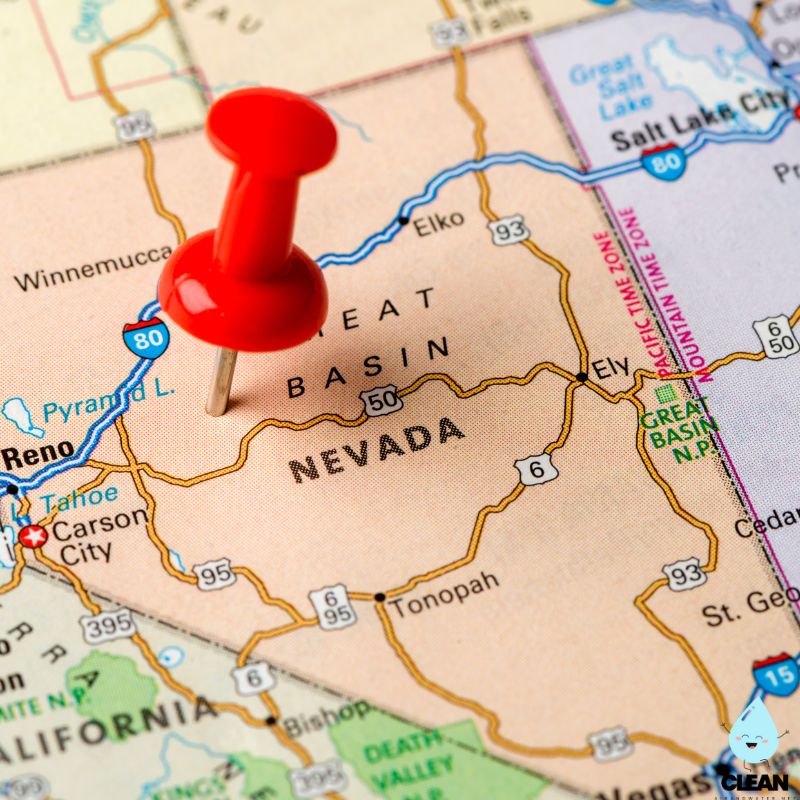
Nevada’s geology is the primary threat to private well owners. The state sits within the Great Basin — one of the largest geothermal provinces in the world — where tectonic activity, fault lines, and volcanic history have resulted in groundwater naturally rich in arsenic, uranium, manganese, lithium, and other heavy metals. Unlike contamination from industrial accidents or spills, this is a geological baseline. Many wells are contaminated before anyone has ever used them.
In a 2022 peer-reviewed study published in Science of the Total Environment — using data from the Healthy Nevada Project — researchers tested water samples from 174 private well households across Northern Nevada. They found that 22% had arsenic concentrations exceeding the EPA maximum contaminant level (MCL) of 10 µg/L. The maximum observed concentration in that domestic well study was approximately 80 times the EPA guideline. Separately, a broader USGS survey of 190 groundwater samples from wells and springs across Nevada (2007–2021) recorded concentrations ranging up to 2,408 µg/L — 240 times above the legal limit — reflecting the extreme variability of naturally occurring arsenic in Nevada’s geology. These two datasets are distinct: the DRI domestic well figure reflects what people are actually drinking; the USGS survey maps the full geological range across the state.
The same study found uranium exceeded federal or health-based guidelines in 8% of wells, with uranium concentrations up to five times the EPA guideline. Iron, manganese, lithium, and molybdenum were also detected above safe levels in various wells. These are not trace detections — they are meaningful exceedances in a substantial minority of Nevada’s domestic well supply.
A separate 2023 study by the Desert Research Institute (DRI), published in Environmental Science and Technology, used a predictive model across the western Great Basin and found that approximately 49,000 domestic well users across Northern Nevada, northeastern California, and western Utah face a greater than 50% probability of elevated arsenic (above 5 µg/L) — with much of the risk concentrated in Nevada. This is the scientific consensus, not a fringe estimate. The DRI’s lead researcher was direct: “What we are finding is that in our region, we have a high probability for elevated arsenic compared to most other regions in the country.” Private wells are the primary drinking water source for approximately 182,000 Nevadans, according to the DRI study.
The highest-risk basins are the Carson Desert (Fallon area), Carson Valley (Minden and Gardnerville), and Truckee Meadows (Reno). In the Lahontan Valley near Fallon, the USGS found that wells deeper than 50 feet had elevated radioactivity — including uranium decay products and polonium-210 — at levels exceeding federal drinking water standards in 11 of 63 wells tested.
PFAS in Nevada Well Water
PFAS contamination in Nevada is primarily a military base issue. Nellis Air Force Base and Creech Air Force Base, both near Las Vegas, have faced scrutiny over the use of AFFF firefighting foam, which was the primary source of PFAS contamination at military installations across the US. Our Las Vegas city page reports groundwater at Nellis AFB showing 47,400 ppt PFOA+PFOS — a figure not affecting the main public supply, but one that represents a meaningful monitored risk for any residential wells in adjacent areas.
In Northern Nevada, PFAS has been detected in public water systems around Reno. A March 2025 report from the Reno Gazette-Journal identified that in Lemmon Valley, PFOS levels were found more than three times above the EPA’s new federal limits, with eight types of PFAS detected across eight locations. These are public water system findings, not private well data — but they confirm PFAS is present in the groundwater environment in Northern Nevada, and private wells drawing from the same aquifer systems are not exempt.
Nevada’s PFAS Action Plan, developed through the Nevada Division of Environmental Protection (NDEP) under Assembly Bill 97 (2021), focuses on public water systems. Private well owners near military bases or known PFAS-affected areas are not covered by any mandatory monitoring programme. The NDEP approved a statewide sampling contract for all public water systems in November 2024 — but that programme does not extend to private wells.
Quick Important Advertisement – Boil Water Alerts continue below
Don’t Wait for the Next Emergency to Act
Boil water alerts are a warning sign. Whether caused by pipe breaks, contamination, or natural disasters, they highlight how vulnerable our water systems can be.
The safest long-term solution? A reliable home water filtration system designed to remove bacteria, parasites, and harmful chemicals — so you’re protected even when advisories are issued.
Stay Ready with Trusted Filtration:
✅ Removes pathogens, chlorine, PFAS, and heavy metals
✅ Safer than boiling alone — no need to wait for alerts
✅ Easy options for homes, renters, and families
Prefer no installation? Check out the A2 Countertop System
Note: This advert may contain affiliate links. If you choose to buy, we may receive a small commission — thank you for supporting our work!
Nitrate and Bacteria Risks
Nitrate contamination affects agricultural valleys in Nevada, particularly the Snake Valley, Carson Valley, and Pahrump Valley. Irrigation runoff and fertiliser application introduce nitrate into shallow aquifers, where it can reach levels dangerous for infants under six months. The Nevada Health Division warns against drinking well water above 10 mg/L nitrate — the same threshold as the federal EPA MCL for public water systems.
Coliform bacteria contamination can occur in any private well where the wellhead is improperly sealed, surface water enters the casing during flooding, or a septic system is situated too close to the well. In Nevada’s rural communities — many with older infrastructure and wide lot spacing — the risk is meaningful but manageable with annual testing and proper well maintenance.
Regulatory Situation for Nevada Well Owners
Private residential wells in Nevada are not regulated under the Nevada Safe Drinking Water Regulations or the federal Safe Drinking Water Act. The state has no authority to mandate testing of private wells, and there is no state-run notification system for well owners near known contamination areas. Well drilling and construction is regulated under Nevada Administrative Code (NAC) 534, but water quality monitoring after the well is installed is entirely the homeowner’s responsibility.
Nevada does not have its own state PFAS MCLs for drinking water — the state is following the federal framework, which sets limits of 4 ppt for PFOA and PFOS (retained May 2025, compliance deadline extended to 2031). Those federal standards apply to public water systems only, not private wells.
Check our Nevada municipal water quality page for city-by-city tap water data, or use our live boil water notice tracker for active advisories across the state.
Known High-Risk Areas in Nevada
If you live near any of the following locations, well water testing is urgent — not precautionary.
Fallon & Carson Desert, Churchill County
The highest arsenic concentrations in the state are recorded here, driven by geothermal fault activity. USGS testing found elevated radioactivity in 11 of 63 deep wells tested. Uranium decay products including polonium-210 have been detected above federal drinking water standards.
Carson Valley — Minden & Gardnerville
One of the three highest-risk basins in the DRI predictive model. Both arsenic and nitrate risks are present — arsenic from geology, nitrate from the valley’s extensive agricultural use. Shallow wells are particularly vulnerable.
Truckee Meadows, Reno Area
Third-highest arsenic risk basin per the DRI study. PFAS has also been detected in Lemmon Valley public water systems at more than three times the EPA limit — private wells in the same groundwater basin should be tested for both arsenic and PFAS.
Nellis AFB Area, Clark County
Groundwater at Nellis Air Force Base has shown PFOA+PFOS at 47,400 ppt — over 11,000 times above the federal 4 ppt limit. This contamination is in base groundwater, not the public supply, but residential wells near the installation boundary should be tested for PFAS urgently.
Pahrump Valley, Nye County
Nitrate contamination from agriculture, combined with naturally occurring arsenic and manganese, makes Pahrump Valley wells a multi-contaminant risk. Shallow domestic wells are most vulnerable to nitrate intrusion from irrigation and septic activity.
Western & Central Nevada — Broad Geothermal Zone
The DRI model predicts more than a 50% probability of elevated arsenic in alluvial-aquifer wells across much of western and central Nevada, including areas without named contamination sites. If you have a well in this region, assume risk until testing proves otherwise.
How to Test Your Nevada Well Water — and What to Do Next
Given Nevada’s contamination profile, every private well owner in the state should test for arsenic and metals — regardless of location. The DRI research is unambiguous: the state’s geology creates baseline arsenic risk in the majority of the state’s groundwater basins, and 22% of tested wells in Northern Nevada already exceed the federal limit. Arsenic is colourless, odourless, and tasteless. You cannot detect it without a laboratory test.
For testing, contact your local county health department or the Nevada State Health Laboratory for certified lab referrals. The Healthy Nevada Project has conducted free-to-low-cost well testing through research participation. In the Fallon area, the Churchill County Hospital can help transport samples to the Nevada State Health Laboratory in Reno.
For treatment, Nevada DEP recommends reverse osmosis (RO) systems or strong-base anion-exchange filters for arsenic. Standard pitcher filters and most basic under-sink units do not remove arsenic effectively. For PFAS, only reverse osmosis has been confirmed to reduce concentrations reliably. Our well water filter guide covers the best whole-house and point-of-use systems for Nevada’s specific risk profile, and you can browse our full water filter solutions page or check your ZIP code for local water quality context.
For municipal water data, see our pages for Las Vegas, Reno, and North Las Vegas, or the full Nevada state water quality page. For other western well water risks, our Michigan wells page covers the highest PFAS-risk state in the country. Return to the private well water directory to find your state.
Quality News About Your Water
Get the comprehensive water quality news coverage you need with our dedicated US Water News Service. From coast to coast, we deliver in-depth reporting and expert analysis on PFAS contamination, EPA regulatory changes, infrastructure developments, and emerging water safety issues affecting communities nationwide. While mainstream media only covers the biggest stories, we provide the detailed, ongoing coverage that helps you understand the full scope of America’s water challenges.
What’s actually in your tap water? Enter your ZIP code for a full breakdown of contaminants detected in your local supply
Drinking water from a well? Check our directory here for more information
Please read – our information
The information presented on cleanairandwater.net is compiled from official water quality reports, trusted news sources, government websites, and public health resources. While we strive for accuracy and thoroughness in our presentations, we are not scientists, engineers, or qualified water quality professionals.
Our mission is to present water quality information in an accessible, real-world format that helps people understand what’s in their water and make informed decisions about their health and safety. We believe that complex environmental information should be available to everyone in a format that’s easy to understand.
We make every effort to ensure our content is current and accurate, but we cannot guarantee that all information is complete or error-free. This website should not replace official communications from your local water utility or health department. We always recommend consulting official sources for the most up-to-date information regarding your specific water system.
Clean Air and Water is not liable for any unintentional errors, omissions, or outdated information. The content on this site is provided for informational purposes only and should not be considered professional advice.